Nursing practice questions with comprehensive rationales
NurseDive Free Nursing Practice Question
The nurse is performing tracheostomy care for a client when a code blue is called for another client on the unit who experiences a cardiopulmonary arrest. Which action should the nurse take?
A. Call for an assistant.
Tracheostomy care is done to keep the trach tube clean and prevent infections.It involves suctioning and cleaning parts of the tube and the skin around the stoma. A code blue is a hospital emergency code that indicates a life-threatening situation, such as cardiac or respiratory arrest.It requires immediate attention from trained personnel. According to the American Association of Critical-Care Nurses (AACN), the nurse should take the following action in this scenario: Call for an assistant to stay with the client who is receiving tracheostomy care and continue the procedure. Respond to the code blue and assist with resuscitation efforts for the other client. Return to the client who is receiving tracheostomy care as soon as possible and complete the procedure. Therefore, the correct answer isa. Call for an assistant.
B. Respond to the code.
Tracheostomy care is done to keep the trach tube clean and prevent infections.It involves suctioning and cleaning parts of the tube and the skin around the stoma. A code blue is a hospital emergency code that indicates a life-threatening situation, such as cardiac or respiratory arrest.It requires immediate attention from trained personnel. According to the American Association of Critical-Care Nurses (AACN), the nurse should take the following action in this scenario: Call for an assistant to stay with the client who is receiving tracheostomy care and continue the procedure. Respond to the code blue and assist with resuscitation efforts for the other client. Return to the client who is receiving tracheostomy care as soon as possible and complete the procedure. Therefore, the correct answer isa. Call for an assistant.
C. Finish the procedure.
Tracheostomy care is done to keep the trach tube clean and prevent infections.It involves suctioning and cleaning parts of the tube and the skin around the stoma. A code blue is a hospital emergency code that indicates a life-threatening situation, such as cardiac or respiratory arrest.It requires immediate attention from trained personnel. According to the American Association of Critical-Care Nurses (AACN), the nurse should take the following action in this scenario: Call for an assistant to stay with the client who is receiving tracheostomy care and continue the procedure. Respond to the code blue and assist with resuscitation efforts for the other client. Return to the client who is receiving tracheostomy care as soon as possible and complete the procedure. Therefore, the correct answer isa. Call for an assistant.
D. Close the room door.
Tracheostomy care is done to keep the trach tube clean and prevent infections.It involves suctioning and cleaning parts of the tube and the skin around the stoma. A code blue is a hospital emergency code that indicates a life-threatening situation, such as cardiac or respiratory arrest.It requires immediate attention from trained personnel. According to the American Association of Critical-Care Nurses (AACN), the nurse should take the following action in this scenario: Call for an assistant to stay with the client who is receiving tracheostomy care and continue the procedure. Respond to the code blue and assist with resuscitation efforts for the other client. Return to the client who is receiving tracheostomy care as soon as possible and complete the procedure. Therefore, the correct answer isa. Call for an assistant.
This question is an excerpt from Nurse Dive's nursing test bank - RN Hesi Exit Proctored Exam. Take the full exam now
Full Explanation
Tracheostomy care is done to keep the trach tube clean and prevent infections. It involves suctioning and cleaning parts of the tube and the skin around the stoma. A code blue is a hospital emergency code that indicates a life-threatening situation, such as cardiac or respiratory arrest. It requires immediate attention from trained personnel.
- Call for an assistant to stay with the client who is receiving tracheostomy care and continue the procedure.
- Respond to the code blue and assist with resuscitation efforts for the other client.
- Return to the client who is receiving tracheostomy care as soon as possible and complete the procedure.
Therefore, the correct answer is a. Call for an assistant.
Similar Questions
The parent of a child born with a myelomeningocele asks the nurse, "What did I do to deserve this?" Which response is most helpful?
A. "You didn't do anything wrong."
Telling the parent “You didn’t do anything wrong” might seem comforting, but it doesn’t address the parent’s feelings of guilt or responsibility.It’s important to remember that myelomeningocele is a birth defect that occurs when the spine and spinal cord do not develop completely1.It’s often not known why this happens, but it can be due to a combination of genetic and environmental factors2. Therefore, it’s not something the parent did or didn’t do.
B. "Is there any particular reason why you think this is your fault?"
Asking “Is there any particular reason why you think this is your fault?” could potentially lead to a constructive conversation. However, it might also make the parent feel defensive or as if they need to justify their feelings. It’s crucial to approach this situation with empathy and understanding, acknowledging the parent’s feelings without making them feel judged.
C. "This must be a very difficult time for you."
Saying “This must be a very difficult time for you” is the most helpful response because it acknowledges the parent’s feelings and offers empathy. It doesn’t place blame or make assumptions. Instead, it opens up a space for the parent to express their feelings and concerns.
D. "With surgery, your baby should have a full recovery."
While it’s true that surgery can help manage the condition1, saying “With surgery, your baby should have a full recovery” might be misleading.Myelomeningocele is the most severe form of spina bifida and can cause moderate to severe disabilities, such as muscle weakness, loss of bladder or bowel control, and/or paralysis2. Each case is unique, and while some children may have less severe symptoms, others may require lifelong management. It’s important to provide accurate and realistic information. Remember, it’s essential to approach these conversations with empathy and understanding. Parents dealing with a diagnosis of myelomeningocele are likely experiencing a range of emotions, and they need support and accurate information.
Full Explanation
The correct answer is Choice C: “This must be a very difficult time for you.”
Choice A rationale: Telling the parent “You didn’t do anything wrong” might seem comforting, but it doesn’t address the parent’s feelings of guilt or responsibility. It’s important to remember that myelomeningocele is a birth defect that occurs when the spine and spinal cord do not develop completely1. It’s often not known why this happens, but it can be due to a combination of genetic and environmental factors2. Therefore, it’s not something the parent did or didn’t do.
Choice B rationale: Asking “Is there any particular reason why you think this is your fault?” could potentially lead to a constructive conversation. However, it might also make the parent feel defensive or as if they need to justify their feelings. It’s crucial to approach this situation with empathy and understanding, acknowledging the parent’s feelings without making them feel judged.
Choice C rationale: Saying “This must be a very difficult time for you” is the most helpful response because it acknowledges the parent’s feelings and offers empathy. It doesn’t place blame or make assumptions. Instead, it opens up a space for the parent to express their feelings and concerns.
Choice D rationale: While it’s true that surgery can help manage the condition1, saying “With surgery, your baby should have a full recovery” might be misleading. Myelomeningocele is the most severe form of spina bifida and can cause moderate to severe disabilities, such as muscle weakness, loss of bladder or bowel control, and/or paralysis2. Each case is unique, and while some children may have less severe symptoms, others may require lifelong management. It’s important to provide accurate and realistic information.
Remember, it’s essential to approach these conversations with empathy and understanding. Parents dealing with a diagnosis of myelomeningocele are likely experiencing a range of emotions, and they need support and accurate information.
A client who weighs 110 pounds receives a prescription for dalteparin 150 units/kg subcutaneously daily for 4 months. The medication is available in 7,500 units/0.3 mL prefilled syringe. How many mL should the nurse administer?
(Enter numerical value only.)
Full Explanation
To calculate the mL of dalteparin to administer, we need to determine the total number
of units required for the client and then convert it to the volume based on the concentration provided.
First, we need to calculate the total number of units required: Weight of the client: 110 pounds
Dalteparin dosage: 150 units/kg Duration of treatment: 4 months
To convert the client's weight from pounds to kilograms, we divide it by 2.2: 110 pounds / 2.2 = 50 kilograms
Next, we calculate the total number of units required:
150 units/kg * 50 kilograms = 7,500 units
Now we can calculate the volume to administer:
7,500 units / 7,500 units/0.3 mL = 0.3 mL
Therefore, the nurse should administer 0.3 mL of dalteparin.
The nurse is providing care to a client having surgery to repair a retinal detachment to the left eye. Which intervention should the nurse implement during the postoperative period?
A. Obtain vital signs every 2 hours during hospitalization.
Obtaining vital signs every 2 hours during hospitalization is a routine nursing intervention for postoperative care in general but is not specific to retinal detachment surgery. The frequency of vital sign monitoring may vary depending on the client's overall condition and the healthcare provider's orders.
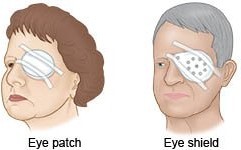
B. Provide an eye shield to be worn while sleeping.
After retinal detachment surgery, it is crucial to protect the eye and the surgical repair site from accidental trauma or pressure. Providing an eye shield helps to shield the eye during sleep when the client may not have conscious control over their movements. This can help prevent inadvertent rubbing or bumping of the eye, which could potentially disrupt the surgical repair and hinder the healing process.
C. Teach a family member to administer eye drops.
Teaching a family member to administer eye drops may be necessary for the client's ongoing care, but it is not specifically related to the immediate postoperative period. Eye drop administration instructions can be provided as part of the client's discharge teaching.
D. Encourage deep breathing and coughing exercises.
Encouraging deep breathing and coughing exercises is a general postoperative intervention that promotes respiratory function and helps prevent complications such as pneumonia. While important for overall postoperative care, it is not specific to retinal detachment surgery.
Full Explanation
After retinal detachment surgery, it is crucial to protect the eye and the surgical repair site from accidental trauma or pressure. Providing an eye shield helps to shield the eye during sleep when the client may not have conscious control over their movements.
This can help prevent inadvertent rubbing or bumping of the eye, which could potentially disrupt the surgical repair and hinder the healing process.
Obtaining vital signs every 2 hours during hospitalization is a routine nursing intervention for postoperative care in general but is not specific to retinal detachment surgery. The frequency of vital sign monitoring may vary depending on the client's overall condition and the healthcare provider's orders.
Teaching a family member to administer eye drops may be necessary for the client's ongoing care, but it is not specifically related to the immediate postoperative period. Eye drop administration instructions can be provided as part of the client's discharge teaching.
Encouraging deep breathing and coughing exercises is a general postoperative intervention that promotes respiratory function and helps prevent complications such as pneumonia. While important for overall postoperative care, it is not specific to retinal detachment surgery.