
Nursing practice questions with comprehensive rationales
NurseDive Free Nursing Practice Question
The nurse is preparing discharge instructions for a patient with a history of diabetes who has just been diagnosed with seizure disorder. The patient has been prescribed hydantoin therapy. What will the patient most likely experience?
A. Hyperglycemia
Hyperglycemia:Hyperglycemia refers to high blood sugar levels. While certain medications can affect glucose metabolism and potentially lead to hyperglycemia as a side effect, this is not typically associated with hydantoin therapy for seizure disorder. Therefore, it is less likely for the patient to experience hyperglycemia as a direct result of taking hydantoin medication.
B. Hunger
Hunger:Hunger is not a common side effect of hydantoin therapy for seizure disorder. While some medications may affect appetite or cause changes in eating habits, hunger is not a typical side effect of hydantoin medications such as phenytoin.
C. Hypoglycemia
Hypoglycemia: Hypoglycemia refers to low blood sugar levels, which can lead to symptoms such as confusion, dizziness, sweating, and weakness. Hydantoin medications, particularly phenytoin, can affect glucose metabolism and increase the risk of hypoglycemia, especially in patients who already have diabetes or are prone to low blood sugar. Therefore, it is important for patients taking hydantoin therapy to monitor their blood sugar levels regularly and be aware of the signs and symptoms of hypoglycemia.
D. Pupil dilation
Pupil dilation:Pupil dilation, or mydriasis, is not a common side effect of hydantoin therapy for seizure disorder. While certain medications may affect pupil size, this is not typically associated with hydantoin medications such as phenytoin.
This question is an excerpt from Nurse Dive's nursing test bank - Ati Lpn Med Surg Neuro Test 2024 Proctored Exam. Take the full exam now
Full Explanation
A. Hyperglycemia:
Hyperglycemia refers to high blood sugar levels. While certain medications can affect glucose metabolism and potentially lead to hyperglycemia as a side effect, this is not typically associated with hydantoin therapy for seizure disorder. Therefore, it is less likely for the patient to experience hyperglycemia as a direct result of taking hydantoin medication.
B. Hunger:
Hunger is not a common side effect of hydantoin therapy for seizure disorder. While some medications may affect appetite or cause changes in eating habits, hunger is not a typical side effect of hydantoin medications such as phenytoin.
C. Hypoglycemia:
Hypoglycemia refers to low blood sugar levels, which can lead to symptoms such as confusion, dizziness, sweating, and weakness. Hydantoin medications, particularly phenytoin, can affect glucose metabolism and increase the risk of hypoglycemia, especially in patients who already have diabetes or are prone to low blood sugar. Therefore, it is important for patients taking hydantoin therapy to monitor their blood sugar levels regularly and be aware of the signs and symptoms of hypoglycemia.
D. Pupil dilation:
Pupil dilation, or mydriasis, is not a common side effect of hydantoin therapy for seizure disorder. While certain medications may affect pupil size, this is not typically associated with hydantoin medications such as phenytoin.
Similar Questions
Which condition would indicate to the nurse that the patient has a phenytoin (Dilantin) toxicity?
A. Nystagmus
Nystagmus:Nystagmus is an involuntary, rhythmic movement of the eyes, which can be rapid and jerky. It is a common neurological manifestation of phenytoin toxicity. Patients experiencing phenytoin toxicity may exhibit horizontal or vertical nystagmus, which can be detected upon physical examination.
B. Strabismus
Strabismus:Strabismus, also known as crossed eyes or squint, refers to a misalignment of the eyes. While strabismus can have various causes, it is not typically associated with phenytoin toxicity. Therefore, it is less likely to indicate phenytoin toxicity compared to nystagmus.
C. Blurry vision
Blurry vision: Blurry vision, or visual disturbances, can occur in patients experiencing phenytoin toxicity. However, it is a non-specific symptom and can be observed in various other conditions as well. Patients with phenytoin toxicity may experience blurry vision, double vision (diplopia), or other visual disturbances due to the effects of the medication on the central nervous system.
D. Amblyopia
Amblyopia:Amblyopia, also known as lazy eye, is a condition characterized by reduced vision in one or both eyes. It is typically associated with visual development during childhood and is not directly related to phenytoin toxicity. Therefore, it is less likely to indicate phenytoin toxicity compared to nystagmus or other neurological manifestations.
Full Explanation
A. Nystagmus:
Nystagmus is an involuntary, rhythmic movement of the eyes, which can be rapid and jerky. It is a common neurological manifestation of phenytoin toxicity. Patients experiencing phenytoin toxicity may exhibit horizontal or vertical nystagmus, which can be detected upon physical examination.
B. Strabismus:
Strabismus, also known as crossed eyes or squint, refers to a misalignment of the eyes. While strabismus can have various causes, it is not typically associated with phenytoin toxicity. Therefore, it is less likely to indicate phenytoin toxicity compared to nystagmus.
C. Blurry vision:
Blurry vision, or visual disturbances, can occur in patients experiencing phenytoin toxicity. However, it is a non-specific symptom and can be observed in various other conditions as well. Patients with phenytoin toxicity may experience blurry vision, double vision (diplopia), or other visual disturbances due to the effects of the medication on the central nervous system.
D. Amblyopia:
Amblyopia, also known as lazy eye, is a condition characterized by reduced vision in one or both eyes. It is typically associated with visual development during childhood and is not directly related to phenytoin toxicity. Therefore, it is less likely to indicate phenytoin toxicity compared to nystagmus or other neurological manifestations.
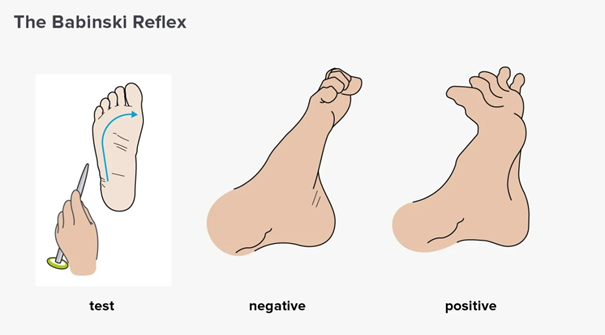
The nurse documents an abnormal finding from the Babinski reflex as a (the):
A. toes turning up and spreading
Toes turning up and spreading:This description corresponds to the abnormal finding in the Babinski reflex. In a positive Babinski sign, the big toe (hallux) dorsiflexes (turns upward) and the other toes fan out. This response is abnormal in adults but normal in infants up to a certain age.
B. downward curl of the toes
Downward curl of the toes:This response is typical of the normal plantar reflex, where the toes curl downward (plantar flexion) in response to stimulation of the sole of the foot. It is not indicative of the Babinski reflex.
C. pain in the big toe
Pain in the big toe: Pain in the big toe is not a characteristic finding of the Babinski reflex. The Babinski sign is assessed by observing the movement pattern of the toes in response to stimulation, rather than eliciting pain.
D. big toe bending upward
Big toe bending upward:The big toe bending upward, or dorsiflexion of the big toe, is a specific component of the positive Babinski sign. However, it is typically accompanied by spreading of the other toes, which is the hallmark feature of the Babinski reflex.
Full Explanation
A. Toes turning up and spreading:
This description corresponds to the abnormal finding in the Babinski reflex. In a positive Babinski sign, the big toe (hallux) dorsiflexes (turns upward) and the other toes fan out. This response is abnormal in adults but normal in infants up to a certain age.
B. Downward curl of the toes:
This response is typical of the normal plantar reflex, where the toes curl downward (plantar flexion) in response to stimulation of the sole of the foot. It is not indicative of the Babinski reflex.
C. Pain in the big toe:
Pain in the big toe is not a characteristic finding of the Babinski reflex. The Babinski sign is assessed by observing the movement pattern of the toes in response to stimulation, rather than eliciting pain.
D. Big toe bending upward:
The big toe bending upward, or dorsiflexion of the big toe, is a specific component of the positive Babinski sign. However, it is typically accompanied by spreading of the other toes, which is the hallmark feature of the Babinski reflex.
A nurse is preparing to administer valproic acid 500 mg PO. Available is valproic acid oral solution 250 mg/5 mL. How many mL should the nurse administer? (Round the answer to the nearest whole number. Use a leading zero if it applies. Do not use a trailing zero.)
Full Explanation
To calculate the dose of valproic acid oral solution, the nurse should use the following formula:
Dose (mL) = Ordered dose (mg) / Concentration (mg/mL) x Volume (mL)
Plugging in the values from the question, we get:
Dose (mL) = 500 mg / (250 mg / 5 mL) x 5 mL
Simplifying, we get:
Dose (mL) = 500 mg / 50 mg x 5 mL
Dose (mL) = 10 mL
Therefore, the nurse should administer 10 of valproic acid oral solution to the patient.