
Nursing practice questions with comprehensive rationales
NurseDive Free Nursing Practice Question
The nurse is preparing to administer a suspension ampicillin labeled, 250 mg/5 mL, to a child with impetigo. The prescription is for 500 mg four times a day. How many mL should the child receive per day?
(Enter numeric value only.)
This question is an excerpt from Nurse Dive's nursing test bank - RN Hesi Exit Proctored Exam. Take the full exam now
Full Explanation
To determine the amount of mL the child should receive per day, we need to calculate the total daily dose of ampicillin based on the prescription.
The prescription is for 500 mg of ampicillin four times a day, so the total daily dose is: 500 mg × 4 times = 2000 mg/day
The concentration of the suspension is 250 mg/5 mL, which means that there are 250 mg of ampicillin in every 5 mL.
To find out how many mL the child should receive per day, we divide the total daily dose by the concentration:
2000 mg ÷ 250 mg/5 mL = 40 mL/day
Therefore, the child should receive 40 mL of the ampicillin suspension per day.
Similar Questions
The nurse is performing an admission assessment for a newborn who has asymmetrical buttocks. Which assessment test results should the nurse report to the healthcare provider?
A. Ortolani maneuver causing a click at the hip joint.
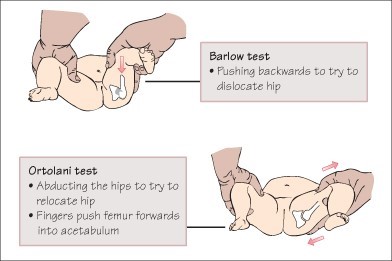
The Ortolani maneuver is a physical examination technique used to assess for developmental dysplasia of the hip (DDH) in newborns. During the maneuver, the nurse gently abducts the infant's hips and applies gentle pressure to detect any instability or "click" at the hip joint. A positive Ortolani maneuver, where a click or clunk is felt or heard, can indicate the presence of a hip dislocation or dysplasia. Asymmetrical buttocks can be a sign of hip dysplasia in newborns, and a positive Ortolani maneuver is an important finding that suggests a potential hip joint problem. Reporting this assessment test result to the healthcare provider allows for further evaluation and appropriate management of the newborn's hip condition.
B. Plumb line test indicates fetal position curvature.
The Plumb line test, which assesses fetal position curvature, is not directly related to hip dysplasia and may not be significant in this context.
C. Babinski test that reveals fanning out of toes.
The Babinski test, which reveals fanning out of the toes, is used to assess the integrity of the infant's neurological system and is not specific to hip dysplasia.
D. Moro test precipitating a startle response.
The Moro test, also known as the startle response, is a reflex assessment used to evaluate the newborn's neurological and sensory function. While it is important to assess the overall neurological status of the newborn, the Moro test is not specific to hip dysplasia.
Full Explanation
The Ortolani maneuver is a physical examination technique used to assess for developmental dysplasia of the hip (DDH) in newborns. During the maneuver, the nurse gently abducts the infant's hips and applies gentle pressure to detect any instability or "click" at the hip joint. A positive Ortolani maneuver, where a click or clunk is felt or heard, can indicate the presence of a hip dislocation or dysplasia.
Asymmetrical buttocks can be a sign of hip dysplasia in newborns, and a positive Ortolani maneuver is an important finding that suggests a potential hip joint problem. Reporting this assessment test result to the healthcare provider allows for further evaluation and appropriate management of the newborn's hip condition.
The Plumb line test, which assesses fetal position curvature, is not directly related to hip dysplasia and may not be significant in this context.
The Babinski test, which reveals fanning out of the toes, is used to assess the integrity of the infant's neurological system and is not specific to hip dysplasia.
The Moro test, also known as the startle response, is a reflex assessment used to evaluate the newborn's neurological and sensory function. While it is important to assess the overall neurological status of the newborn, the Moro test is not specific to hip dysplasia.
When planning care for an adolescent with anorexia nervosa, which nursing problem has the highest priority?
A. Disturbed Body Image.
B. Interrupted Family Processes.
C. Imbalanced Nutrition: less than body requirements.
Imbalanced Nutrition: less than body requirements would be the nursing problem with the highest priority for an adolescent with anorexia nervosa. Anorexia nervosa is characterized by a severe restriction of food intake leading to a significantly low body weight, which can have serious physical and psychological consequences. Therefore, addressing the client's malnutrition and promoting adequate nutrition intake is crucial to prevent further complications. Disturbed Body Image, Interrupted Family Processes, and Noncompliance with treatment regimen are important nursing problems to address, but they are secondary to the client's malnutrition.
D. Noncompliance with treatment regimen.
Full Explanation
Imbalanced Nutrition: less than body requirements would be the nursing problem with the highest priority for an adolescent with anorexia nervosa. Anorexia nervosa is characterized by a severe restriction of food intake leading to a significantly low body weight, which can have serious physical and psychological consequences. Therefore, addressing the client's malnutrition and promoting adequate nutrition intake is crucial to prevent further complications. Disturbed Body Image, Interrupted Family Processes, and Noncompliance with treatment regimen are important nursing problems to address, but they are secondary to the client's malnutrition.
A client with Addison's disease becomes weak, confused, and dehydrated following the onset of an acute viral infection. The client's laboratory values include: sodium 129 mEq/L (129 mmol/L), glucose 54 mg/dl (2.97 mmol/L) and potassium 5.3 mEq/L (5.3 mmol/L).
When reporting the findings to the healthcare provider, the nurse anticipates a prescription for which intravenous medication?
Reference Ranges
- Sodium [Reference Range: Adult 136 to 145 mEq/L (136 to 145 mmol/L)
- Glucose (Reference Range: 0 to 50 years: 74 to 106 mg/dl. (4.1 to 5.9 mmol/L))
- Potassium [Reference Range: 3.5 to 5.0 mEq/L (3.5 to 5.0 mmol/L)
A. Broad spectrum antibiotic.
A broad-spectrum antibiotic may be necessary if there is evidence of a bacterial infection, but it does not directly address the symptoms associated with Addison's disease.
B. Regular insulin.
Regular insulin is used for managing high blood glucose levels in conditions such as diabetes, but in this case, the client has low glucose levels, so insulin is not the appropriate intervention.
C. Hydrocortisone.
The client with Addison's disease is experiencing weakness, confusion, and dehydration, which can be indicative of an adrenal crisis. The low sodium level (129 mEq/L) and low glucose level (54 mg/dl) further support this suspicion. An acute viral infection can trigger an adrenal crisis in individuals with Addison's disease. Intravenous hydrocortisone, a glucocorticoid, is the treatment of choice for managing an adrenal crisis. It helps to replenish cortisol levels and stabilize the client's condition. Hydrocortisone helps in restoring the body's stress response and regulating electrolyte and glucose levels.
D. Potassium chloride.
Potassium chloride is a medication used to treat low potassium levels (hypokalemia), but the client's potassium level is within the reference range (5.3 mEq/L). Therefore, potassium chloride is not indicated in this situation.
Full Explanation
The client with Addison's disease is experiencing weakness, confusion, and dehydration, which can be indicative of an adrenal crisis. The low sodium level (129 mEq/L) and low glucose level (54 mg/dl) further support this suspicion. An acute viral infection can trigger an adrenal crisis in individuals with Addison's disease.
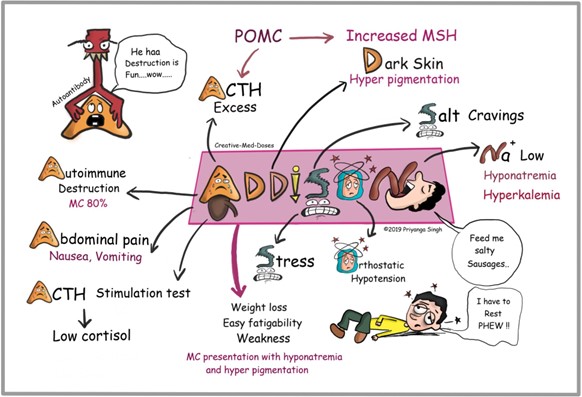
Intravenous hydrocortisone, a glucocorticoid, is the treatment of choice for managing an adrenal crisis. It helps to replenish cortisol levels and stabilize the client's condition.
Hydrocortisone helps in restoring the body's stress response and regulating electrolyte and glucose levels.
A broad-spectrum antibiotic may be necessary if there is evidence of a bacterial infection, but it does not directly address the symptoms associated with Addison's disease.
Regular insulin is used for managing high blood glucose levels in conditions such as diabetes, but in this case, the client has low glucose levels, so insulin is not the appropriate intervention.
Potassium chloride is a medication used to treat low potassium levels (hypokalemia), but the client's potassium level is within the reference range (5.3 mEq/L). Therefore, potassium chloride is not indicated in this situation.