Nursing practice questions with comprehensive rationales
NurseDive Free Nursing Practice Question
Upon entrance into a mental health care system, clients are thoroughly assessed, and this is followed by the development of a mental health treatment plan. Which of the following are the purposes of the treatment plan? (Select all that apply.)
A. A means of monitoring the client's progress
the mental health treatment is designed to monitor and assess an individual’s progress and response to treatment over time by outlining measurable and realistic targets that are evaluated periodically.
B. A guide for planning and implementation of care
the treatment plan can be used by healthcare providers as a guide while providing care to their clients by issuing a clear rationale behind the interventions chosen.
C. An instrument for communication and coordination of care
the treatment plan is a document outlining the objectives, interventions, and expected outcomes in the management of clients thus it serves as a communication tool amongst various healthcare providers across all the cadres involved in multi-disciplinary patient care.
D. Evaluating the effectiveness of interventions
the treatment plan evaluates the effectiveness of the interventions provided to a client by providing a comparison between the actual results and the expected outcomes thus guiding on the need for any necessary adjustments to be made when needed.
E. Ensure that the client follows their treatment
the treatment plan is not primarily responsible for ensuring that a client adheres to their treatment but instead it empowers and supports them during their recovery process. Therefore, the client’s needs and preferences should always be considered while developing the treatment plan which should be flexible to the changing needs of clients.
This question is an excerpt from Nurse Dive's nursing test bank - ATI ns 130 Exam Psychosocial Proctored Exam. Take the full exam now
Full Explanation
Choice A rationale: the mental health treatment is designed to monitor and assess an individual’s progress and response to treatment over time by outlining measurable and realistic targets that are evaluated periodically.
Choice B rationale: the treatment plan can be used by healthcare providers as a guide while providing care to their clients by issuing a clear rationale behind the interventions chosen.
Choice C rationale: the treatment plan is a document outlining the objectives, interventions, and expected outcomes in the management of clients thus it serves as a communication tool amongst various healthcare providers across all the cadres involved in multi-disciplinary patient care.
Choice D rationale: the treatment plan evaluates the effectiveness of the interventions provided to a client by providing a comparison between the actual results and the expected outcomes thus guiding on the need for any necessary adjustments to be made when needed.
Choice E rationale: the treatment plan is not primarily responsible for ensuring that a client adheres to their treatment but instead it empowers and supports them during their recovery process. Therefore, the client’s needs and preferences should always be considered while developing the treatment plan which should be flexible to the changing needs of clients.
Similar Questions
A client in the mental health unit has a history of Asthma. Which axis would the nurse document this information?
A. Axis 3
Axis 3 is used in the documentation of conditions, for instance, asthma, hypertension, and diabetes mellitus among others which are known to have effects on an individual’s mental health.
B. AXIS 2
Axis 2 is used in the documentation of conditions affecting a client’s functioning such as personality disorders and mental retardation.
C. Axis 4
Axis 4 is used in the documentation of environmental and psychosocial issues contributing to a patient’s stress such as financial and family stressors.
D. Axis1
Axis 1 is used to document clinical disorders that are the primary focus of management such as schizophrenia, major depressive disorder, and bipolar disorder among others.
Full Explanation
Choice A rationale: Axis 3 is used in the documentation of conditions, for instance, asthma, hypertension, and diabetes mellitus among others which are known to have effects on an individual’s mental health.
Choice B rationale: Axis 2 is used in the documentation of conditions affecting a client’s functioning such as personality disorders and mental retardation.
Choice C rationale: Axis 4 is used in the documentation of environmental and psychosocial issues contributing to a patient’s stress such as financial and family stressors.
Choice D rationale: Axis 1 is used to document clinical disorders that are the primary focus of management such as schizophrenia, major depressive disorder, and bipolar disorder among others.
What is the therapeutic range of Lithium (Eskalith)?
A. 0.6-1.5
The therapeutic range of lithium is generally considered to be 0.6-1.5 mEq/L. However, some patients may require higher or lower levels depending on their individual response to the medication and their clinical condition. Lithium has a narrow therapeutic range hence the blood level of the drug should be closely monitored to minimize the risk of toxicity and sub-therapeutic effects.
B. 0.1-0.5
0.1-0.5 is too low hence the drug will provide sub-optimal effects thus providing inadequate mood stabilization.
C. 0.2-0.5
0.2-0.5 is too low hence the drug will provide sub-optimal effects thus providing inadequate mood stabilization.
D. 0.4-1.6
0.4-1.6 the lower limit is too low and may result in sub-therapeutic effects while the upper limit is too high and increases the risk of lithium toxicity which can manifest as nausea, vomiting, tremors, seizures, and death in severe cases.
Full Explanation
Choice A rationale: The therapeutic range of lithium is generally considered to be 0.6-1.5 mEq/L. However, some patients may require higher or lower levels depending on their individual response to the medication and their clinical condition. Lithium has a narrow therapeutic range hence the blood level of the drug should be closely monitored to minimize the risk of toxicity and sub-therapeutic effects.
Choice B rationale: 0.1-0.5 is too low hence the drug will provide sub-optimal effects thus providing inadequate mood stabilization.
Choice C rationale: 0.2-0.5 is too low hence the drug will provide sub-optimal effects thus providing inadequate mood stabilization.
Choice D rationale: 0.4-1.6 the lower limit is too low and may result in sub-therapeutic effects while the upper limit is too high and increases the risk of lithium toxicity which can manifest as nausea, vomiting, tremors, seizures, and death in severe cases.
Which medication side effect is irreversible if not caught early:
A. Akathisia
Choice A rationale: Akathisia refers to restlessness and agitation and is a common side effect of antipsychotic medications. This condition can be reversed by reducing the dose of antipsychotic medication taken by the client.
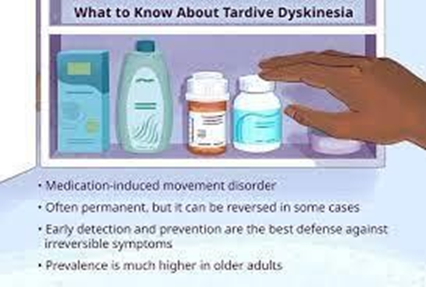
B. Tardive Dyskinesia
Choice B rationale: Tardive dyskinesia refers to the involuntary movement of body parts such as the limbs, face, jaw, and tongue and is a common side effect of long-term use of first-generation antipsychotic medications which work by blocking dopamine receptors. This condition is irreversible, especially when not detected early.
C. Dystonia
Choice C rationale: Dystonia which refers to muscle spasms affecting the jaw, eyes, and limbs can be reversed by the use of anticholinergic medications or botulin toxin.
D. Akinesia
Choice D: Akinesia refers to the absence of movement and can be managed by adjusting the dosage of the antipsychotic medications being taken by the patient.
Full Explanation
Choice A rationale: Akathisia refers to restlessness and agitation and is a common side effect of antipsychotic medications. This condition can be reversed by reducing the dose of antipsychotic medication taken by the client.
Choice B rationale: Tardive dyskinesia refers to the involuntary movement of body parts such as the limbs, face, jaw, and tongue and is a common side effect of long-term use of first-generation antipsychotic medications which work by blocking dopamine receptors. This condition is irreversible, especially when not detected early.
Choice C rationale: Dystonia which refers to muscle spasms affecting the jaw, eyes, and limbs can be reversed by the use of anticholinergic medications or botulin toxin.
Choice D: Akinesia refers to the absence of movement and can be managed by adjusting the dosage of the antipsychotic medications being taken by the patient.