
Nursing practice questions with comprehensive rationales
NurseDive Free Nursing Practice Question
When caring for the client with Alzheimer's disease, which of the following are appropriate items to include in the client's room?
A. complete darkness at night.
Incorrect. Complete darkness at night can increase confusion and agitation in clients with Alzheimer's disease. The room should have adequate lighting and a night light to help orient the client and prevent falls.
B. suction equipment
Incorrect. Suction equipment is not necessary for clients with Alzheimer's disease unless they have respiratory problems or difficulty swallowing. Suction equipment can be noisy and frightening for clients with cognitive impairment and should be avoided unless indicated.
C. walker or cane
Incorrect. A walker or cane may be helpful for clients with Alzheimer's disease who have mobility issues, but it is not an essential item to include in the room. A walker or cane can also pose a tripping hazard or be used as a weapon by agitated clients.
D. clocks, calendar, family photos
Correct. Clocks, calendar, family photos are appropriate items to include in the room of a client with Alzheimer's disease. They can help the client maintain orientation to time, place, and person, and provide comfort and familiarity.
This question is an excerpt from Nurse Dive's nursing test bank - Ati med surg adult care 2 proctored exam. Take the full exam now
Full Explanation
A. Incorrect. Complete darkness at night can increase confusion and agitation in clients with Alzheimer's disease. The room should have adequate lighting and a night light to help orient the client and prevent falls.
B. Incorrect. Suction equipment is not necessary for clients with Alzheimer's disease unless they have respiratory problems or difficulty swallowing. Suction equipment can be noisy and frightening for clients with cognitive impairment and should be avoided unless indicated.
C. Incorrect. A walker or cane may be helpful for clients with Alzheimer's disease who have mobility issues, but it is not an essential item to include in the room. A walker or cane can also pose a tripping hazard or be used as a weapon by agitated clients.
D. Correct. Clocks, calendar, family photos are appropriate items to include in the room of a client with Alzheimer's disease. They can help the client maintain orientation to time, place, and person, and provide comfort and familiarity.
Similar Questions
A client arrives to the emergency department after a motor vehicle accident. The nurse records the following Glasgow Coma scores: E3, V2, M1. What is the best first action for the nurse to take.
A. Assess vital signs
Assess vital signs. This is not the best first action because the client has a very low Glasgow Coma score (6 out of 15), which indicates a severe brain injury and a high risk of respiratory failure. The priority is to secure the airway and provide oxygenation.
B. Ask the client about medications
Ask the client about medications. This is not the best first action because the client is unlikely to be able to respond verbally due to the low level of consciousness and possible brain damage. The nurse should obtain the medication history from other sources, such as family or paramedics.
C. Ask the client what he recalls from the accident
Ask the client what he recalls from the accident. This is not the best first action because the client is not alert or oriented and may not have any memory of the accident due to the braininjury. The nurse should focus on assessing and stabilizing the client's physical condition.
D. Prepare the client for mechanical ventilation
Prepare the client for mechanical ventilation. This is the best first action because the client has a very low Glasgow Coma score and may lose the ability to breathe spontaneously or maintain adequate oxygenation. The nurse should prepare the equipment and medications for intubation and mechanical ventilation, and notify the physician.
The nurse takes report on a client who was admitted with a severe heada
che, nausea, vomiting, photophobia, and a stiff neck. Which of the following is the priority intervention for the nurse to perform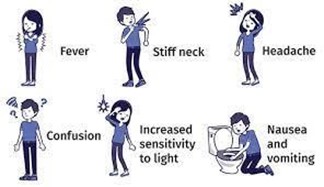 ?
?
A. Prepare the client for a MRI
Prepare the client for a MRI. This is not the priority intervention because it does not addressthe possible cause of the client's symptoms, which are suggestive of meningitis, an inflammation of the meninges that can be caused by bacteria or viruses. A MRI may be ordered later to rule out other causes of headache, such as tumor or hemorrhage, but it is not urgent.
B. Monitor for increased intracranial pressure
Monitor for increased intracranial pressure. This is an important intervention, but not the priority one, because it does not treat the underlying infection that may be causing the increased intracranial pressure. The nurse should monitor for signs of increased intracranial pressure, such as changes in level of consciousness, pupil reaction, vital signs, and neurological status, but also administer antibiotics as soon as possible.
C. Administer penicillin
Administer penicillin. This is the priority intervention because it can treat bacterial meningitis, which is a lifethreatening condition that requires immediate antibiotic therapy. The nurse should obtain blood cultures before administering penicillin, but should not delay treatment if cultures are not available.
D. Identify if the client has had a recent respiratory illness
Identify if the client has had a recent respiratory illness. This is not the priority intervention because it does not provide immediate relief or treatment for the client's symptoms or infection. The nurse should ask about recent exposure to respiratory infections, such as influenza or streptococcus, as part of the history taking, but this is not urgent.
A nurse is assessing a client who has Parkinson's disease. Which of the following manifestations should the nurse expect?
A. Pruritus
Pruritus is not a manifestation of Parkinson's disease. It is a sensation of itching that can have various causes, such as dry skin, allergies, or infections.
B. Hypertension
Hypertension is not a manifestation of Parkinson's disease. It is a condition of high blood pressure that can increase the risk of cardiovascular complications, such as stroke or heart attack.
C. Bradykinesia
Bradykinesia is a manifestation of Parkinson's disease. It is a term that means slow movement and refers to the difficulty in initiating and performing voluntary actions, such as walking, speaking, or swallowing.
D. Xerostomia
Xerostomia is not a manifestation of Parkinson's disease. It is a term that means dry mouth and can result from dehydration, medication side effects, or salivary gland disorders.