
Nursing practice questions with comprehensive rationales
NurseDive Free Nursing Practice Question
Where is the ventral respiratory group located?
A. In the lungs
In the lungs -Control centers are in the brainstem, not lungs.
B. In the pons
In the pons -The pons houses the pneumotaxic and apneustic centers.
C. In the midbrain
In the midbrain -The midbrain controls reflexes, not primary breathing rhythm.
D. In the medulla oblongata
In the medulla oblongata -The VRG in the medulla generates the basic breathing rhythm.
This question is an excerpt from Nurse Dive's nursing test bank - Anatomy and physiology proctored exam (Ivy college). Take the full exam now
Full Explanation
A. In the lungs -Control centers are in the brainstem, not lungs.
B. In the pons -The pons houses the pneumotaxic and apneustic centers.
C. In the midbrain -The midbrain controls reflexes, not primary breathing rhythm.
D. In the medulla oblongata -The VRG in the medulla generates the basic breathing rhythm.
Similar Questions
"I'm going to hold my breath until I die and it will be all your fault!" shrieked 6-year-old Riley at her father. Why would she be unable to carry out her threat?
A. Decreased CO2 and hydrogen ion concentrations and increased oxygen concentration stimulate her chemoreceptors, triggering inspiration.
Decreased CO₂ and hydrogen ion concentrations and increased oxygen concentration stimulate her chemoreceptors, triggering inspiration. - Chemoreceptors respond to increased CO₂/decreased O₂.
B. The inflation reflex would not her allow to keep her lungs full of air for a prolonged period. The reflex would trigger inspiration.
The inflation reflex would not allow her to keep her lungs full of air for a prolonged period. The reflex would trigger inspiration. -The Hering–Breuer reflex prevents overinflation, not relevant here.
C. Increased CO2 and hydrogen ion concentrations and decreased oxygen concentration stimulate her chemoreceptors, triggering inspiration.
Increased CO₂ and hydrogen ion concentrations and decreased oxygen concentration stimulate her chemoreceptors, triggering inspiration. -Rising CO₂ strongly stimulates medullary chemoreceptors → involuntary breathing resumes.
D. The diaphragm will begin to fatigue and will not be able to hold its contracted position for more than a short period of time.
The diaphragm will begin to fatigue and will not be able to hold its contracted position for more than a short period of time. -Breathing resumes due to chemoreceptor drive before muscle fatigue sets in.
Full Explanation
A. Decreased CO₂ and hydrogen ion concentrations and increased oxygen concentration stimulate her chemoreceptors, triggering inspiration. - Chemoreceptors respond to increased CO₂/decreased O₂.
B. The inflation reflex would not allow her to keep her lungs full of air for a prolonged period. The reflex would trigger inspiration. -The Hering–Breuer reflex prevents overinflation, not relevant here.
C. Increased CO₂ and hydrogen ion concentrations and decreased oxygen concentration stimulate her chemoreceptors, triggering inspiration. -Rising CO₂ strongly stimulates medullary chemoreceptors → involuntary breathing resumes.
D. The diaphragm will begin to fatigue and will not be able to hold its contracted position for more than a short period of time. -Breathing resumes due to chemoreceptor drive before muscle fatigue sets in.
In the digestive tract, what organ is found just inferior to the esophagus?
Fill in the blank
Full Explanation
The esophagus passes through the diaphragm and empties into the stomach (cardia region), so the stomach lies immediately inferior to the distal esophagus.
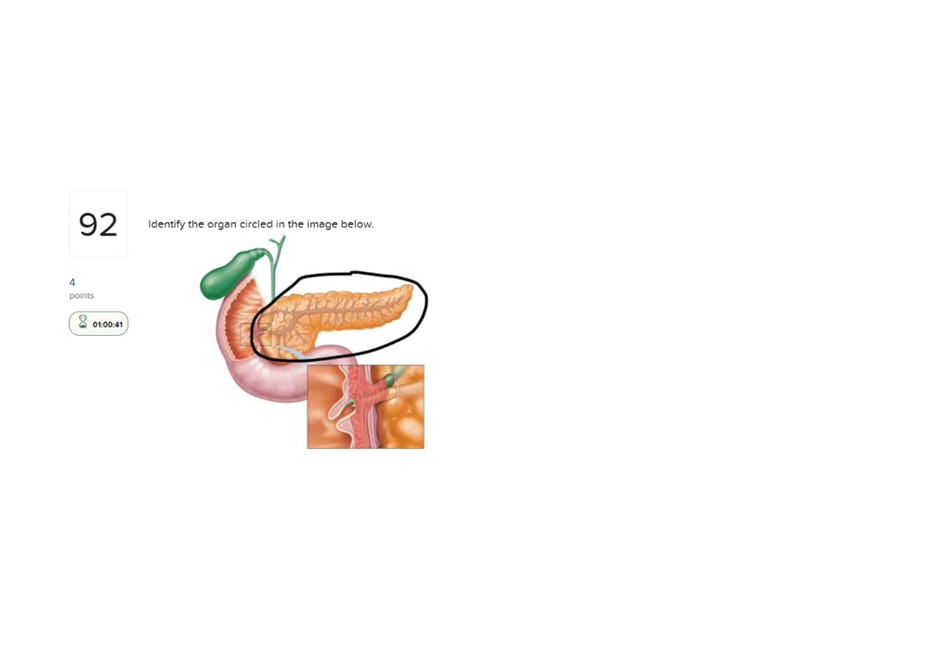
Identify the organ circled in the image below.
Fill in the blank
Full Explanation
The circled organ is the pancreas -it sits posterior to the stomach across the posterior abdominal wall and has both exocrine (digestive enzymes) and endocrine (insulin/glucagon) functions.