
Nursing practice questions with comprehensive rationales
NurseDive Free Nursing Practice Question
Which disorder is associated with the compression of the bilateral nerve roots of the lumbosacral region?
A. Anterior spinal artery syndrome
Anterior spinal artery syndrome is caused by ischemia of the anterior two-thirds of the spinal cord, resulting in loss of motor function and pain and temperature sensation below the level of the lesion.
B. Cauda equina syndrome
This is a condition that occurs when the nerve roots in the lower end of the spinal cord are compressed, causing symptoms such as lower back pain, sciatica, saddle anesthesia, bladder and bowel dysfunction, and sexual dysfunction.
C. Horner's syndrome
Horner's syndrome is caused by damage to the sympathetic nerve fibers in the neck or chest, resulting in drooping eyelid, constricted pupil, and lack of sweating on one side of the face.
D. Brown-Séquard syndrome
Brown-Séquard syndrome is caused by hemisection of the spinal cord, resulting in ipsilateral loss of motor function and proprioception and contralateral loss of pain and temperature sensation below the level of the lesion.
This question is an excerpt from Nurse Dive's nursing test bank - Interprofessional Care of the Client and Family Across the Lifespan II Proctored Exam. Take the full exam now
Full Explanation
Choice A rationale: Anterior spinal artery syndrome is caused by ischemia of the anterior two-thirds of the spinal cord, resulting in loss of motor function and pain and temperature sensation below the level of the lesion.
Choice B rationale: This is a condition that occurs when the nerve roots in the lower end of the spinal cord are compressed, causing symptoms such as lower back pain, sciatica, saddle anesthesia, bladder and bowel dysfunction, and sexual dysfunction.
Choice C rationale: Horner's syndrome is caused by damage to the sympathetic nerve fibers in the neck or chest, resulting in drooping eyelid, constricted pupil, and lack of sweating on one side of the face.
Choice D rationale: Brown-Séquard syndrome is caused by hemisection of the spinal cord, resulting in ipsilateral loss of motor function and proprioception and contralateral loss of pain and temperature sensation below the level of the lesion.
Similar Questions
The nurse cares for a client six hours post-operative following a transurethral resection of a prostate (TURP).
The client is demonstrating signs and symptoms of ?
A. urinary catheter obstruction
The signs and symptoms of urinary catheter obstruction include hematuria with clots, bladder spasms, and a feeling of urinary urgency. The nurse should increase the rate of the continuous bladder irrigation to flush out the clots and relieve the obstruction. The nurse should also monitor the client's vital signs, fluid balance, and pain level. The other options are not consistent with the client's presentation.
B. shock
Shock would cause hypotension, tachycardia, and decreased urine output.
C. hyponatremia
Hyponatremia would cause confusion, weakness, and seizures.
D. urinary tract infection
Urinary tract infection would cause fever, chills, and foul-smelling urine.
Full Explanation
Choice A rationale: The signs and symptoms of urinary catheter obstruction include hematuria with clots, bladder spasms, and a feeling of urinary urgency. The nurse should increase the rate of the continuous bladder irrigation to flush out the clots and relieve the obstruction. The nurse should also monitor the client's vital signs, fluid balance, and pain level. The other options are not consistent with the client's presentation.
Choice B rationale: Shock would cause hypotension, tachycardia, and decreased urine output.
Choice C rationale: Hyponatremia would cause confusion, weakness, and seizures.
Choice D rationale: Urinary tract infection would cause fever, chills, and foul-smelling urine.
Which of the following imagine the nurse will recognize as a positive evidence of adenomyosis?
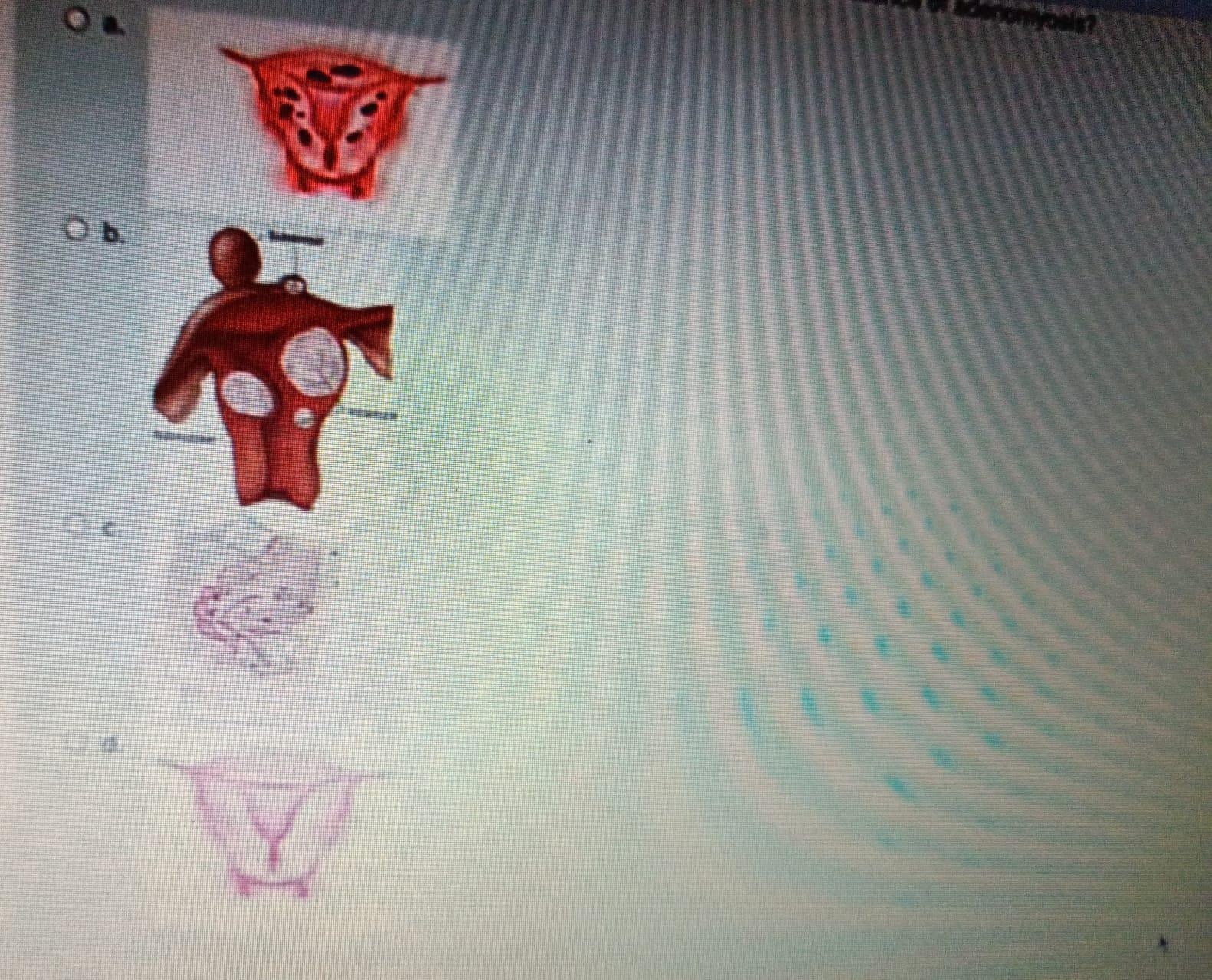
A. A
this is the correct answer since the darkened spots in the uterus represent endometrial-like tissue growths within the muscular wall of the uterus (the myometrium).
B. B
This picture shows leiomyomas, also known as fibroids, which are benign tumors that develop from the smooth muscle cells of the uterus. They can vary in size, number, and location within or outside the uterus. They can cause symptoms such as heavy bleeding, pelvic pressure, pain, and infertility.
C. C
This is endometriosis which is a condition where tissue similar to the endometrium (the lining of the uterus) grows outside the uterus, such as on the ovaries, fallopian tubes, pelvic wall, or bowel. This tissue responds to hormonal changes and bleeds during the menstrual cycle, causing inflammation, pain, and sometimes infertility.
D. D
this image shows a normal uterus.
Full Explanation
Choice A rationale: this is the correct answer since the darkened spots in the uterus represent endometrial-like tissue growths within the muscular wall of the uterus (the myometrium).
Choice B rationale: This picture shows leiomyomas, also known as fibroids, which are benign tumors that develop from the smooth muscle cells of the uterus. They can vary in size, number, and location within or outside the uterus. They can cause symptoms such as heavy bleeding, pelvic pressure, pain, and infertility.
Choice C rationale: This is endometriosis which is a condition where tissue similar to the endometrium (the lining of the uterus) grows outside the uterus, such as on the ovaries, fallopian tubes, pelvic wall, or bowel. This tissue responds to hormonal changes and bleeds during the menstrual cycle, causing inflammation, pain, and sometimes infertility.
Choice D rationale: This image shows a normal uterus.
The nurse in the women's health clinic has four patients who are waiting to be seen. Which patient should the nurse see first?
A. A 42-yr-old patient with secondary amenorrhea who says that her last menstrual cycle was 3 months ago
The 42-yr-old patient with secondary amenorrhea may have menopause, pregnancy, or a hormonal disorder. This is less urgent compared to the 19- year old patient.
B. A 19-yr-old patient with menorrhagia who has been using superabsorbent tampons and has fever with weakness
This patient may have toxic shock syndrome, which is a life- threatening complication of tampon use that can cause organ failure and shock. The nurse should assess the patient's vital signs, remove the tampon, and initiate fluid resuscitation and antibiotic therapy.
C. A 22-yr-old patient with persistent red-brown vaginal drainage 3 days after having balloon thermotherapy
This patient may have an infection or a complication of the balloon thermotherapy, which is a procedure to destroy the endometrial lining of the uterus and is not an emergency compared to the 19 year old.
D. A 35-yr-old patient with heavy spotting after having a progestin-containing IUD (Mirena) inserted a month ago
This patient may have a displacement or perforation of the IUD, which is a contraceptive device that releases progestin into the uterus. However, this is not urgent compared to the 19 year old.
Full Explanation
Choice A rationale: The 42-yr-old patient with secondary amenorrhea may have menopause, pregnancy, or a hormonal disorder. This is less urgent compared to the 19- year old patient.
Choice B rationale: This patient may have toxic shock syndrome, which is a life- threatening complication of tampon use that can cause organ failure and shock. The nurse should assess the patient's vital signs, remove the tampon, and initiate fluid resuscitation and antibiotic therapy.
Choice C rationale: This patient may have an infection or a complication of the balloon thermotherapy, which is a procedure to destroy the endometrial lining of the uterus and is not an emergency compared to the 19 year old.
Choice D rationale: This patient may have a displacement or perforation of the IUD, which is a contraceptive device that releases progestin into the uterus. However, this is not urgent compared to the 19 year old.