
Nursing practice questions with comprehensive rationales
NurseDive Free Nursing Practice Question
Which process involves gas exchange between the atmosphere and the cells of the body and the resulting chemical reactions that provide the cells with energy to function.
A. respiration
Respiration: Respiration encompasses gas exchange (external/internal) and cellular reactions (cellular respiration) that produce energy
B. oxidation
Oxidation: Oxidation is a chemical process involved in metabolism but does not by itself describe the full gas-exchange-energy sequence
C. metabolism
Metabolism: Metabolism is the sum of biochemical reactions (including energy production) but doesn’t explicitly include atmospheric gas exchange -less precise / incorrect for the combined description.
D. breathing
Breathing: Breathing (ventilation) is the mechanical movement of air and does not include cellular chemical reactions that generate cellular energy
This question is an excerpt from Nurse Dive's nursing test bank - Anatomy and physiology proctored exam (Ivy college). Take the full exam now
Full Explanation
A. Respiration: Respiration encompasses gas exchange (external/internal) and cellular reactions (cellular respiration) that produce energy
B. Oxidation: Oxidation is a chemical process involved in metabolism but does not by itself describe the full gas-exchange-energy sequence
C. Metabolism: Metabolism is the sum of biochemical reactions (including energy production) but doesn’t explicitly include atmospheric gas exchange -less precise / incorrect for the combined description.
D. Breathing: Breathing (ventilation) is the mechanical movement of air and does not include cellular chemical reactions that generate cellular energy
Similar Questions
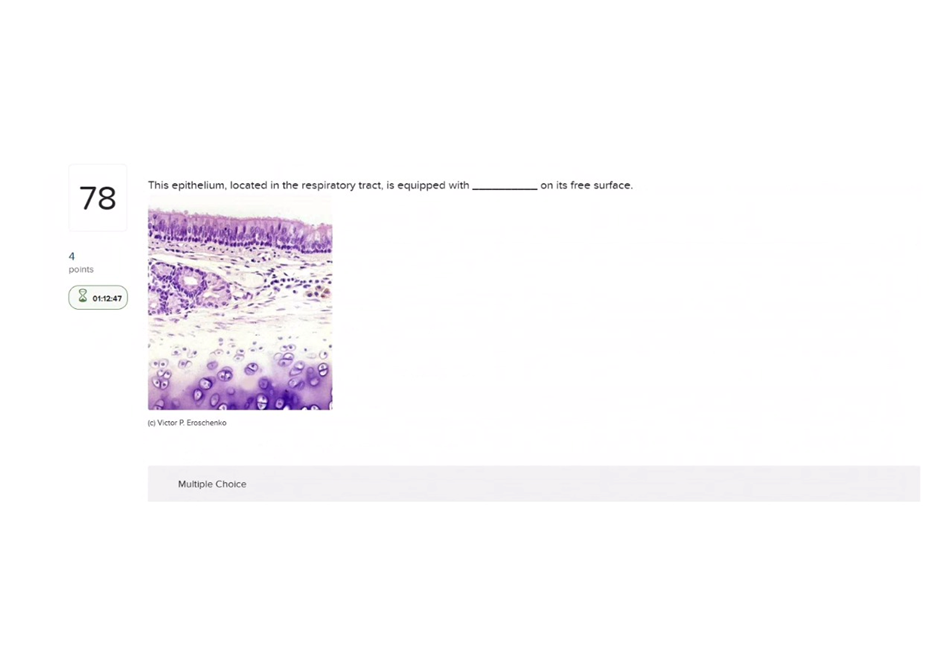
This epithelium, located in the respiratory tract, is equipped with
Full Explanation
A. Microvilli: Microvilli increase surface area for absorption (common in intestines), not the hallmark of respiratory epithelium
B. Cilia: Respiratory epithelium (pseudostratified ciliated columnar) is equipped with cilia on its free surface to move mucus and trapped particles
C. Keratin: Keratinization occurs in skin epithelium (protective), not in the typical respiratory lining
D. Desmosomes: Desmosomes are cell junctions found in many epithelia but the question asks about free-surface specializations; cilia are the functional free-surface structures in respiratory epithelium
What is the anatomical name for the voice box?
A. Pharynx
Pharynx: The pharynx is the throat region (shared airway/digestive pathway), not the voice box
B. Oral cavity
Oral cavity: The oral cavity is the mouth, not the voice box
C. Larynx
Larynx: The larynx is the anatomical name for the voice box
D. Trachea
Trachea: The trachea is the windpipe below the larynx, not the voice box
Full Explanation
A. Pharynx: The pharynx is the throat region (shared airway/digestive pathway), not the voice box
B. Oral cavity: The oral cavity is the mouth, not the voice box
C. Larynx: The larynx is the anatomical name for the voice box
D. Trachea: The trachea is the windpipe below the larynx, not the voice box
Which statement describes the trachea?
A. It is lined with simple squamous epithelium.
It is lined with simple squamous epithelium: The trachea is lined with pseudostratified ciliated columnar epithelium, not simple squamous
B. It contains no air-filtering mechanisms.
It contains no air-filtering mechanisms: the trachea has mucus and ciliated cells that trap and move particles (air-filtering mechanisms present)
C. It is comprised of C-shaped cartilage rings.
It is comprised of C-shaped cartilage rings: The trachea is supported anteriorly by C-shaped hyaline cartilage rings that keep the airway open
D. It is a passageway for food and for air.
It is a passageway for food and for air: The trachea is only an air passageway; the esophagus transports food
Full Explanation
A. It is lined with simple squamous epithelium: The trachea is lined with pseudostratified ciliated columnar epithelium, not simple squamous
B. It contains no air-filtering mechanisms: the trachea has mucus and ciliated cells that trap and move particles (air-filtering mechanisms present)
C. It is comprised of C-shaped cartilage rings: The trachea is supported anteriorly by C-shaped hyaline cartilage rings that keep the airway open
D. It is a passageway for food and for air: The trachea is only an air passageway; the esophagus transports food