Nursing practice questions with comprehensive rationales
NurseDive Free Nursing Practice Question
While working as nurse in a hospital you notice that a co-worker has unsteady gait and slurred speech. You suspect that she may be an impaired nurse.
Which of the following will be the appropriate action to take?
A. Ask your co-worker to perform a sobriety test.
Asking your co-worker to perform a sobriety test (Option a) may also not be appropriate, as you may not be trained or authorized to administer such a test, and it may not be a reliable indicator of impairment.
B. Report your co-worker to the supervisor.
This is because impaired nursing can have serious consequences for patients' safety and well-being, and it is your ethical and professional responsibility to take action to ensure patient safety.
C. Ignore your co-worker’s behavior until others notice the problem.
Ignoring the co-worker's behavior (Option c) is not an appropriate action, as it could potentially harm patients and violate your ethical and professional responsibilities as a nurse.
D. Confront the co-worker with your suspicions.
Confronting the co-worker directly (Option d) may not be the best approach, as it could lead to a confrontational situation and may not resolve the issue.
This question is an excerpt from Nurse Dive's nursing test bank - Mental Health Chapter 1 - Proctored Exam 2. Take the full exam now
Full Explanation
This is because impaired nursing can have serious consequences for patients' safety and well-being, and it is your ethical and professional responsibility to take action to ensure patient safety.
Confronting the co-worker directly ( Option d) may not be the best approach, as it could lead to a confrontational situation and may not resolve the issue. Asking your co-worker to perform a sobriety test ( Option a) may also not be appropriate, as you may not be trained or authorized to administer such a test, and it may not be a reliable indicator of impairment. Ignoring the co-worker's behavior ( Option c) is not an appropriate action, as it could potentially harm patients and violate your ethical and professional responsibilities as a nurse.
Similar Questions
During a client nurse interaction, which nursing statement may give the client false reassurance?
A. I notice you have bitten your nails to the quick.
B. You are jumping in to conclusions.
C. You appear uptight.
D. Don’t worry, everything will be alright.
This statement may give the client false reassurance because it dismisses the client's concerns without acknowledging or addressing them. It is important for the nurse to listen to the client's concerns and provide appropriate interventions and support rather than simply dismissing their worries with a blanket statement. The other Options (a, b, and c) are observations of the client's behavior or appearance, and do not provide false reassurance.
Full Explanation
This statement may give the client false reassurance because it dismisses the client's concerns without acknowledging or addressing them. It is important for the nurse to listen to the client's concerns and provide appropriate interventions and support rather than simply dismissing their worries with a blanket statement. The other
Options (a, b, and c) are observations of the client's behavior or appearance, and do not provide false reassurance.
The capacity to understand or feel what another person is experiencing from within the other persons frame of reference i.e., the capacity to place oneself in another person’s position:
A. Telepathy
Telepathy, on the other hand, refers to the supposed ability to communicate with others through thoughts or mental processes, without the use of normal sensory channels such as sight or sound.
B. Sympathy
Sympathy refers to feelings of pity or sorrow for someone else's misfortune. It involves feeling sorry for someone, but not necessarily understanding or sharing their perspective.
C. Empathy
Empathy is the capacity to understand or feel what another person is experiencing from within the other person's frame of reference. It involves recognizing and sharing the emotions and perspectives of others, without necessarily experiencing the same emotions or perspectives oneself.
D. Apathy
Apathy refers to a lack of interest or concern and can be seen as the opposite of empathy.
Full Explanation
Empathy is the capacity to understand or feel what another person is experiencing from within the other person's frame of reference. It involves recognizing and sharing the emotions and perspectives of others, without necessarily experiencing the same emotions or perspectives oneself.
Telepathy, on the other hand, refers to the supposed ability to communicate with others through thoughts or mental processes, without the use of normal sensory channels such as sight or sound.
Sympathy refers to feelings of pity or sorrow for someone else's misfortune. It involves feeling sorry for someone, but not necessarily understanding or sharing their perspective.
Apathy refers to a lack of interest or concern and can be seen as the opposite of empathy.
The set of rules designed to protect patients who are described as vulnerable are known as?
A. Doctrine of privileged information.
The Doctrine of privileged information refers to the legal concept that certain information shared between a patient and healthcare provider is confidential and cannot be disclosed without the patient’s consent.
B. Collaborative practice.
Collaborative practice refers to the coordinated efforts of healthcare professionals from different disciplines working together to provide comprehensive and high-quality patient care.
C. Patients’ bill of rights.
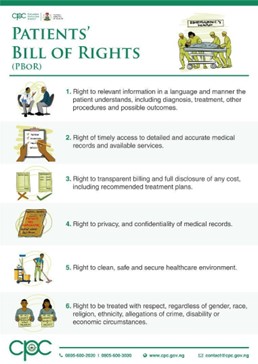
The Patients’ bill of rights is a set of rules that protect patients and ensure that they are treated with dignity, respect, and autonomy. It describes the rights that patients have when they receive medical care and treatment. The Patients’ bill of rights was created to protect patients who are vulnerable and may not have the ability or resources to advocate for themselves.
D. Nurse practice act.
The Nurse practice act is a set of laws that govern the practice of nursing in a specific state or jurisdiction. It outlines the scope of nursing practice and the responsibilities and obligations of nurses.
Full Explanation
The Patients’ bill of rights is a set of rules that protect patients and ensure that they are treated with dignity, respect, and autonomy. It describes the rights that patients have when they receive medical care and treatment. The Patients’ bill of rights was created to protect patients who are vulnerable and may not have the ability or resources to advocate for themselves.
The Doctrine of privileged information refers to the legal concept that certain information shared between a patient and healthcare provider is confidential and cannot be disclosed without the patient’s consent.
Collaborative practice refers to the coordinated efforts of healthcare professionals from different disciplines working together to provide comprehensive and high-quality patient care.
The Nurse practice act is a set of laws that govern the practice of nursing in a specific state or jurisdiction. It outlines the scope of nursing practice and the responsibilities and obligations of nurses.