Nursing practice questions with comprehensive rationales
NurseDive Free Nursing Practice Question
A nurse is assessing a client who has hyperthyroidism. The nurse should expect the client to report which of the following manifestations?
A. Constipation
Constipation is more commonly associated with hypothyroidism, not hyperthyroidism.
B. Frequent mood changes
Hyperthyroidism can lead to emotional lability, anxiety, and irritability due to increased metabolic rate.
C. Weight gain of 4.5 kg (10 lb) in 3 weeks
Weight loss is a common manifestation of hyperthyroidism, not weight gain.
D. Sensitivity to cold
Sensitivity to cold is more commonly associated with hypothyroidism, not hyperthyroidism.
This question is an excerpt from Nurse Dive's nursing test bank - Ati Med Surg Proctored Exam 8. Take the full exam now
Full Explanation
A. Constipation is more commonly associated with hypothyroidism, not hyperthyroidism.
B. Hyperthyroidism can lead to emotional lability, anxiety, and irritability due to increased metabolic rate.
C. Weight loss is a common manifestation of hyperthyroidism, not weight gain.
D. Sensitivity to cold is more commonly associated with hypothyroidism, not hyperthyroidism.
Similar Questions
A nurse is assessing a client who is admitted with hyperthyroidism. The client reports a weight loss of 5.4 kg (12 lb) in the last 2 months, increased appetite, increased perspiration, fatigue, menstrual irregularity, and restlessness. Which of the following actions should the nurse take to prevent a thyroid crisis?
A. Administer aspirin as prescribed for any sign of hyperthermia.
Aspirin administration is not typically indicated for hyperthermia associated with hyperthyroidism as it may displace thyroid hormone from binding proteins.
B. Provide a quiet low stimulus environment.
A calm environment can help prevent exacerbation of symptoms and reduce the risk of a thyroid crisis in hyperthyroid clients.
C. Keep the client NPO.
There is no indication to keep the client NPO solely based on hyperthyroidism.
D. Observe the client carefully for signs of hypocalcemia
Hypocalcemia is not a primary concern in hyperthyroidism. Monitoring for signs of hyperthyroid crisis is more pertinent.
Full Explanation
A. Aspirin administration is not typically indicated for hyperthermia associated with hyperthyroidism as it may displace thyroid hormone from binding proteins.
B. A calm environment can help prevent exacerbation of symptoms and reduce the risk of a thyroid crisis in hyperthyroid clients.
C. There is no indication to keep the client NPO solely based on hyperthyroidism.
D. Hypocalcemia is not a primary concern in hyperthyroidism. Monitoring for signs of hyperthyroid crisis is more pertinent.
A nurse is teaching a client who has chronic kidney failure about planning a low-protein diet. The client states, "Why do I have to be concerned about protein?" Which of the following responses should the nurse make?
A. "A low-protein diet reduces the risk for edema."
Edema in chronic kidney failure is more closely associated with sodium and water retention rather than protein intake.
B. "A low-protein diet will reduce the risk for hyperkalemia
Hyperkalemia in chronic kidney failure can be managed by restricting dietary potassium intake, but it is not primarily related to protein intake.
C. "A low-protein diet will increase the nitrogenous wastes in the blood."
A low-protein diet aims to decrease, not increase, nitrogenous wastes in the blood.
D. "A low protein diet reduces the risk for uremia."
A low-protein diet reduces the risk for uremia, a condition resulting from chronic kidney failure where urea and other waste products build up in the body due to impaired renal function. A low-protein diet helps decrease the workload on the kidneys by reducing the amount of nitrogenous waste they need to filter and excrete.
Full Explanation
A. Edema in chronic kidney failure is more closely associated with sodium and water retention rather than protein intake.
B. Hyperkalemia in chronic kidney failure can be managed by restricting dietary potassium intake, but it is not primarily related to protein intake.
C. A low-protein diet aims to decrease, not increase, nitrogenous wastes in the blood.
D. A low-protein diet reduces the risk for uremia, a condition resulting from chronic kidney failure where urea and other waste products build up in the body due to impaired renal function. A low-protein diet helps decrease the workload on the kidneys by reducing the amount of nitrogenous waste they need to filter and excrete.
A nurse is caring for a client who is 1 day postoperative following a subtotal thyroidectomy. The client reports a tingling sensation in the hands, the soles of the feet, and around the lips. For which of the following findings should the nurse assess the client?
A. Kernig's sign
Kernig's sign is a test for meningitis and is not related to the tingling sensation described by the client.
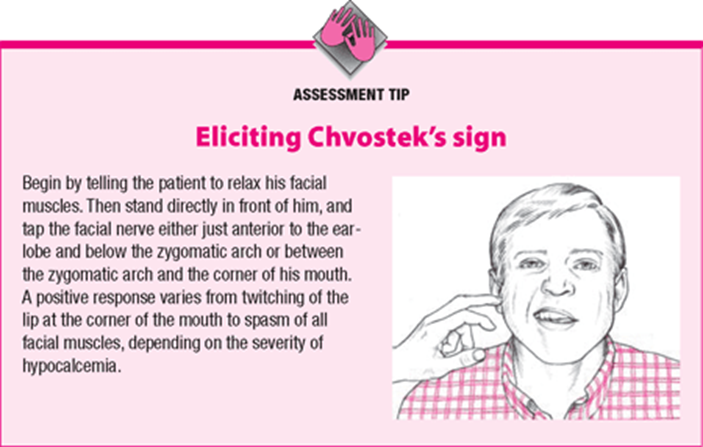
B. Chvostek's sign
Chvostek's sign is a clinical sign of hypocalcemia, which can occur post-thyroidectomy due to inadvertent damage or removal of the parathyroid glands.
C. Babinski's sign
Babinski's sign is a test for upper motor neuron lesions and is not related to the tingling sensation described by the client.
D. Brudzinski's sign
Brudzinski's sign is a test for meningitis and is not related to the tingling sensation described by the client.
Full Explanation
A. Kernig's sign is a test for meningitis and is not related to the tingling sensation described by the client.
B. Chvostek's sign is a clinical sign of hypocalcemia, which can occur post-thyroidectomy due to inadvertent damage or removal of the parathyroid glands.
C. Babinski's sign is a test for upper motor neuron lesions and is not related to the tingling sensation described by the client.
D. Brudzinski's sign is a test for meningitis and is not related to the tingling sensation described by the client.