
Nursing practice questions with comprehensive rationales
NurseDive Free Nursing Practice Question
A nurse is teaching a client who has chronic kidney failure about planning a low-protein diet. The client states, "Why do I have to be concerned about protein?" Which of the following responses should the nurse make?
A. "A low-protein diet reduces the risk for edema."
Edema in chronic kidney failure is more closely associated with sodium and water retention rather than protein intake.
B. "A low-protein diet will reduce the risk for hyperkalemia
Hyperkalemia in chronic kidney failure can be managed by restricting dietary potassium intake, but it is not primarily related to protein intake.
C. "A low-protein diet will increase the nitrogenous wastes in the blood."
A low-protein diet aims to decrease, not increase, nitrogenous wastes in the blood.
D. "A low protein diet reduces the risk for uremia."
A low-protein diet reduces the risk for uremia, a condition resulting from chronic kidney failure where urea and other waste products build up in the body due to impaired renal function. A low-protein diet helps decrease the workload on the kidneys by reducing the amount of nitrogenous waste they need to filter and excrete.
This question is an excerpt from Nurse Dive's nursing test bank - Ati Med Surg Proctored Exam 8. Take the full exam now
Full Explanation
A. Edema in chronic kidney failure is more closely associated with sodium and water retention rather than protein intake.
B. Hyperkalemia in chronic kidney failure can be managed by restricting dietary potassium intake, but it is not primarily related to protein intake.
C. A low-protein diet aims to decrease, not increase, nitrogenous wastes in the blood.
D. A low-protein diet reduces the risk for uremia, a condition resulting from chronic kidney failure where urea and other waste products build up in the body due to impaired renal function. A low-protein diet helps decrease the workload on the kidneys by reducing the amount of nitrogenous waste they need to filter and excrete.
Similar Questions
A nurse is caring for a client who is 1 day postoperative following a subtotal thyroidectomy. The client reports a tingling sensation in the hands, the soles of the feet, and around the lips. For which of the following findings should the nurse assess the client?
A. Kernig's sign
Kernig's sign is a test for meningitis and is not related to the tingling sensation described by the client.
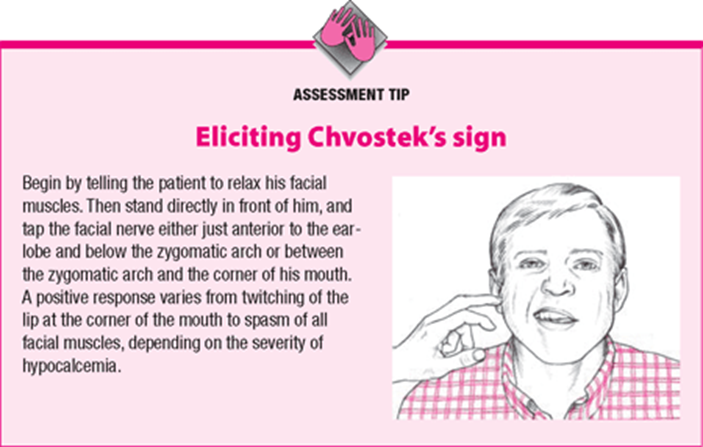
B. Chvostek's sign
Chvostek's sign is a clinical sign of hypocalcemia, which can occur post-thyroidectomy due to inadvertent damage or removal of the parathyroid glands.
C. Babinski's sign
Babinski's sign is a test for upper motor neuron lesions and is not related to the tingling sensation described by the client.
D. Brudzinski's sign
Brudzinski's sign is a test for meningitis and is not related to the tingling sensation described by the client.
Full Explanation
A. Kernig's sign is a test for meningitis and is not related to the tingling sensation described by the client.
B. Chvostek's sign is a clinical sign of hypocalcemia, which can occur post-thyroidectomy due to inadvertent damage or removal of the parathyroid glands.
C. Babinski's sign is a test for upper motor neuron lesions and is not related to the tingling sensation described by the client.
D. Brudzinski's sign is a test for meningitis and is not related to the tingling sensation described by the client.
A nurse is caring for a client who has Addison's disease and is at risk for Addisonian crisis. Which of the following actions should the nurse take?
A. Administer oral corticosteroids.
Administering corticosteroids is crucial during an Addisonian crisis but typically involves intravenous corticosteroids (not oral) during the crisis to quickly restore hormone levels. Oral corticosteroids are part of regular maintenance therapy but not an immediate intervention in the crisis.
B. Weigh the client daily.
Weighing the client daily is important to monitor for potential fluid loss, dehydration, or weight changes related to Addison's disease and Addisonian crisis. Clients with Addison’s disease may experience fluid and electrolyte imbalances, so daily weight tracking helps detect early signs of fluid shifts, which are critical in crisis prevention and management.
C. Provide a low-carbohydrate diet.
A low-carbohydrate diet is not recommended for clients with Addison’s disease, as they may need a balanced diet with sufficient carbohydrates to prevent hypoglycemia.
D. Restrict fluid intake
Fluid intake should not be restricted; rather, maintaining adequate hydration is vital. Clients in Addisonian crisis are often at risk for dehydration due to fluid losses and low aldosterone levels, making fluid replacement essential.
Full Explanation
A. Administering corticosteroids is crucial during an Addisonian crisis but typically involves intravenous corticosteroids (not oral) during the crisis to quickly restore hormone levels. Oral corticosteroids are part of regular maintenance therapy but not an immediate intervention in the crisis.
B. Weighing the client daily is important to monitor for potential fluid loss, dehydration, or weight changes related to Addison's disease and Addisonian crisis. Clients with Addison’s disease may experience fluid and electrolyte imbalances, so daily weight tracking helps detect early signs of fluid shifts, which are critical in crisis prevention and management.
C. A low-carbohydrate diet is not recommended for clients with Addison’s disease, as they may need a balanced diet with sufficient carbohydrates to prevent hypoglycemia.
D. Fluid intake should not be restricted; rather, maintaining adequate hydration is vital. Clients in Addisonian crisis are often at risk for dehydration due to fluid losses and low aldosterone levels, making fluid replacement essential.
A nurse is reviewing the medical records of four clients who have an acid-base imbalance. The nurse should recognize that which of the following clients is at risk for metabolic acidosis?
A. A client who has salicylate intoxication
Salicylate intoxication can lead to metabolic acidosis due to the accumulation of salicylic acid, which increases metabolic rate and production of organic acids.
B. A client who is taking a thiazide diuretic
Thiazide diuretics can lead to metabolic alkalosis due to the loss of hydrogen and chloride ions.
C. A client who is vomiting
Vomiting can lead to metabolic alkalosis due to the loss of gastric acid.
D. A client who has diarrhea
Diarrhea can lead to metabolic acidosis due to the loss of bicarbonate-rich fluids.
Full Explanation
A. Salicylate intoxication can lead to metabolic acidosis due to the accumulation of salicylic acid, which increases metabolic rate and production of organic acids.
B. Thiazide diuretics can lead to metabolic alkalosis due to the loss of hydrogen and chloride ions.
C. Vomiting can lead to metabolic alkalosis due to the loss of gastric acid.
D. Diarrhea can lead to metabolic acidosis due to the loss of bicarbonate-rich fluids.