Nursing practice questions with comprehensive rationales
NurseDive Free Nursing Practice Question
A nurse is caring for a client who has a pulmonary embolism and has a new prescription for enoxaparin 1.5 mg/kg/dose subcutaneously every 12 hours. The client weighs 245 lbs. How many mg should the nurse administer per dose? (Round the answer to the nearest whole number. Use a leading zero if it applies. Do not use a trailing zero.)
This question is an excerpt from Nurse Dive's nursing test bank - ATI Med Surg Custom N235 Final Summer 2023 Proctored Exam. Take the full exam now
Full Explanation
To calculate the dose of enoxaparin, follow these steps:
1) Convert the client's weight from pounds to kilograms:
245 lbs / 2.2046 (kg/lb) = 111.13 kg (rounded to the nearest whole number, it's 111 kg).
2) Multiply the weight in kilograms by the prescribed dose per kilogram:
111 kg x 1.5 mg/kg = 166.5 mg.
Round the answer to the nearest whole number, so the nurse should administer 167 mg per dose of enoxaparin every 12 hours to the client with a pulmonary embolism.

Similar Questions
A nurse is caring for a client whose arterial blood gas results show a pH of 7.3 and a PaCO2 of 50 mm Hg. The nurse should identify that the client is experiencing which of the following acid-base imbalances?
A. Respiratory alkalosis
Reason: This is incorrect because respiratory alkalosis is characterized by a high pH and a low PaCO2, indicating that the client is hyperventilating and losing too much carbon dioxide.
B. Metabolic acidosis
Reason: This is incorrect because metabolic acidosis is characterized by a low pH and a low bicarbonate level, indicating that the client has an excess of metabolic acids or a loss of base.
C. Metabolic alkalosis
Reason: This is incorrect because metabolic alkalosis is characterized by a high pH and a high bicarbonate level, indicating that the client has an excess of base or a loss of metabolic acids.
D. Respiratory acidosis
Reason: This is correct because respiratory acidosis is characterized by a low pH and a high PaCO2, indicating that the client is hypoventilating and retaining too much carbon dioxide.
Full Explanation
Choice A Reason: This is incorrect because respiratory alkalosis is characterized by a high pH and a low PaCO2, indicating that the client is hyperventilating and losing too much carbon dioxide.
Choice B Reason: This is incorrect because metabolic acidosis is characterized by a low pH and a low bicarbonate level, indicating that the client has an excess of metabolic acids or a loss of base.
Choice C Reason: This is incorrect because metabolic alkalosis is characterized by a high pH and a high bicarbonate level, indicating that the client has an excess of base or a loss of metabolic acids.
Choice D Reason: This is correct because respiratory acidosis is characterized by a low pH and a high PaCO2, indicating that the client is hypoventilating and retaining too much carbon dioxide.
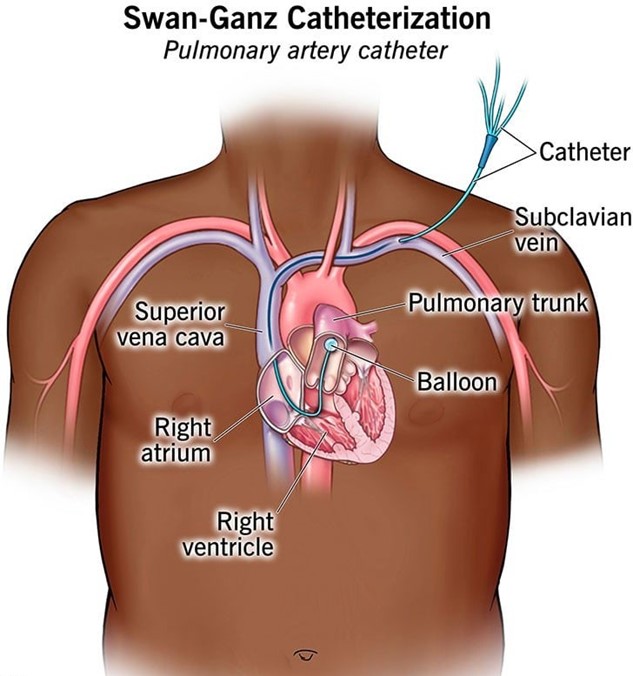
A nurse is preparing a client for transfer to the ICU for placement of a pulmonary artery catheter. The nurse should explain to the client that this catheter is used to monitor which of the following conditions?
A. Hemodynamic status
Reason: This is correct because a pulmonary artery catheter is a device that measures the pressures and flows in the heart and lungs, such as the pulmonary artery pressure, the pulmonary artery wedge pressure, the cardiac output, and the mixed venous oxygen saturation. These parameters reflect the hemodynamic status of the client, which is the balance between the cardiac output and the systemic vascular resistance.
B. Spinal cord perfusion
Reason: This is incorrect because a pulmonary artery catheter does not measure spinal cord perfusion, which is the blood flow to the spinal cord. Spinal cord perfusion can be affected by spinal cord injury, spinal anesthesia, or spinal surgery.
C. Renal function
Reason: This is incorrect because a pulmonary artery catheter does not measure renal function, which is the ability of the kidneys to filter waste products and maintain fluid and electrolyte balance. Renal function can be assessed by urine output, blood urea nitrogen, creatinine, and glomerular filtration rate.
D. Intracranial pressure
Reason: This is incorrect because a pulmonary artery catheter does not measure intracranial pressure, which is the pressure inside the skull. Intracranial pressure can be increased by brain injury, stroke, tumor, infection, or hydrocephalus.
Full Explanation
Choice A Reason: This is correct because a pulmonary artery catheter is a device that measures the pressures and flows in the heart and lungs, such as the pulmonary artery pressure, the pulmonary artery wedge pressure, the cardiac output, and the mixed venous oxygen saturation. These parameters reflect the hemodynamic status of the client, which is the balance between the cardiac output and the systemic vascular resistance.
Choice B Reason: This is incorrect because a pulmonary artery catheter does not measure spinal cord perfusion, which is the blood flow to the spinal cord. Spinal cord perfusion can be affected by spinal cord injury, spinal anesthesia, or spinal surgery.
Choice C Reason: This is incorrect because a pulmonary artery catheter does not measure renal function, which is the ability of the kidneys to filter waste products and maintain fluid and electrolyte balance. Renal function can be assessed by urine output, blood urea nitrogen, creatinine, and glomerular filtration rate.
Choice D Reason: This is incorrect because a pulmonary artery catheter does not measure intracranial pressure, which is the pressure inside the skull. Intracranial pressure can be increased by brain injury, stroke, tumor, infection, or hydrocephalus.
A nurse is caring for a client who has quadriplegia from a spinal cord injury and reports having a severe headache. The nurse obtains a blood pressure reading of 210/108 mm Hg and suspects the client is experiencing autonomic dysreflexia. Which of the following actions should the nurse take first?
A. Administer a nitrate antihypertensive.
Reason: This is incorrect because administering a nitrate antihypertensive is not the first action, as it may cause a rapid drop in blood pressure and worsen the client's condition.
B. Obtain the client's heart rate.
Reason: This is incorrect because obtaining the client's heart rate is not the first action, as it does not address the cause of autonomic dysreflexia or relieve the symptoms.
C. Assess the client for bladder distention.
Reason: This is incorrect because assessing the client for bladder distention is not the first action, as it may take time and delay the treatment of autonomic dysreflexia.
D. Place the client in a high-Fowler's position.
Reason: This is correct because placing the client in a high-Fowler's position is the first action, as it lowers the blood pressure by promoting venous return and reducing cardiac preload.
Full Explanation
Choice A Reason: This is incorrect because administering a nitrate antihypertensive is not the first action, as it may cause a rapid drop in blood pressure and worsen the client's condition.
Choice B Reason: This is incorrect because obtaining the client's heart rate is not the first action, as it does not address the cause of autonomic dysreflexia or relieve the symptoms.
Choice C Reason: This is incorrect because assessing the client for bladder distention is not the first action, as it may take time and delay the treatment of autonomic dysreflexia.
Choice D Reason: This is correct because placing the client in a high-Fowler's position is the first action, as it lowers the blood pressure by promoting venous return and reducing cardiac preload.