
Nursing practice questions with comprehensive rationales
NurseDive Free Nursing Practice Question
A. Buffalo hump
A buffalo hump is a characteristic sign of Cushing’s syndrome. It refers to the accumulation of fat on the back of the neck and shoulders. This symptom occurs due to the excessive production of cortisol, which leads to abnormal fat distribution in the body.
B. Moon face
Moon face is another hallmark of Cushing’s syndrome. It describes the rounding and fullness of the face, which results from fat deposits. This symptom is also caused by prolonged exposure to high levels of cortisol.
C. Hypertension
Hypertension, or high blood pressure, is commonly associated with Cushing’s syndrome. Cortisol increases blood pressure by enhancing the sensitivity of blood vessels to catecholamines and by promoting sodium and water retention.
D. Purple striations
Purple striations, or stretch marks, are often seen in individuals with Cushing’s syndrome. These marks typically appear on the abdomen, thighs, breasts, and arms. They result from the thinning of the skin and the breakdown of collagen due to elevated cortisol levels.
E. Tremors
Tremors are not typically associated with Cushing’s syndrome. While Cushing’s syndrome can cause a variety of symptoms, tremors are more commonly linked to other conditions such as hyperthyroidism or neurological disorders.
This question is an excerpt from Nurse Dive's nursing test bank - Final Med Surg Comprehensive Proctored Exam (Brooklyn University). Take the full exam now
Full Explanation
Choice A reason: A buffalo hump is a characteristic sign of Cushing’s syndrome. It refers to the accumulation of fat on the back of the neck and shoulders. This symptom occurs due to the excessive production of cortisol, which leads to abnormal fat distribution in the body.
Choice B reason: Moon face is another hallmark of Cushing’s syndrome. It describes the rounding and fullness of the face, which results from fat deposits. This symptom is also caused by prolonged exposure to high levels of cortisol.
Choice C reason: Hypertension, or high blood pressure, is commonly associated with Cushing’s syndrome. Cortisol increases blood pressure by enhancing the sensitivity of blood vessels to catecholamines and by promoting sodium and water retention.
Choice D reason: Purple striations, or stretch marks, are often seen in individuals with Cushing’s syndrome. These marks typically appear on the abdomen, thighs, breasts, and arms. They result from the thinning of the skin and the breakdown of collagen due to elevated cortisol levels.
Choice E reason: Tremors are not typically associated with Cushing’s syndrome. While Cushing’s syndrome can cause a variety of symptoms, tremors are more commonly linked to other conditions such as hyperthyroidism or neurological disorders.
Similar Questions
A nurse is caring for a client who has the following arterial blood gas results: HCO3 18 mEq/L, PaCO2 28 mm Hg, and pH 7.30. The nurse recognizes the client is experiencing which of the following acid-base imbalances?
A. Metabolic alkalosis
: Metabolic alkalosis is characterized by an elevated pH (greater than 7.45) and an increased bicarbonate (HCO3) level. In this case, the pH is 7.30, indicating acidosis, and the HCO3 level is 18 mEq/L, which is below the normal range (22-26 mEq/L). Therefore, metabolic alkalosis is not the correct diagnosis.
B. Respiratory alkalosis
: Respiratory alkalosis is indicated by a high pH (greater than 7.45) and a low PaCO2 (less than 35 mm Hg). Although the PaCO2 is low at 28 mm Hg, the pH is 7.30, indicating acidosis rather than alkalosis. Therefore, respiratory alkalosis is not the correct diagnosis.
C. Respiratory acidosis
: Respiratory acidosis is characterized by a low pH (less than 7.35) and an elevated PaCO2 (greater than 45 mm Hg). In this case, the pH is low, indicating acidosis, but the PaCO2 is also low at 28 mm Hg, which does not fit the criteria for respiratory acidosis. Therefore, respiratory acidosis is not the correct diagnosis.
D. Metabolic acidosis
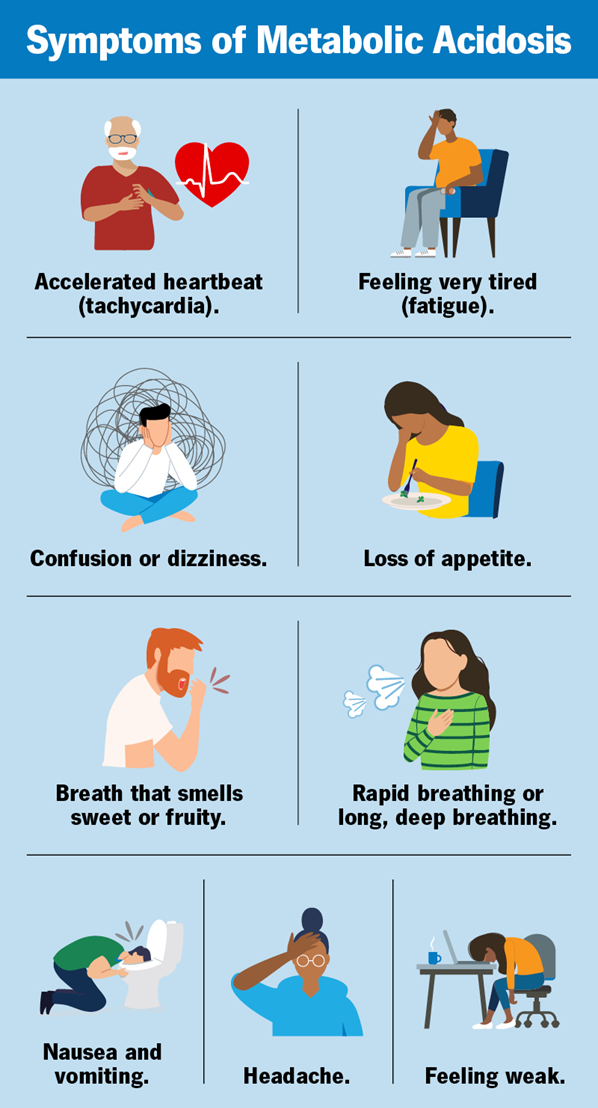
: Metabolic acidosis is indicated by a low pH (less than 7.35) and a low bicarbonate (HCO3) level (less than 22 mEq/L). In this case, the pH is 7.30, indicating acidosis, and the HCO3 level is 18 mEq/L, which is below the normal range. The low PaCO2 of 28 mm Hg suggests a compensatory respiratory response to the metabolic acidosis. Therefore, metabolic acidosis is the correct diagnosis.
Full Explanation
Choice A Reason:
Metabolic alkalosis is characterized by an elevated pH (greater than 7.45) and an increased bicarbonate (HCO3) level. In this case, the pH is 7.30, indicating acidosis, and the HCO3 level is 18 mEq/L, which is below the normal range (22-26 mEq/L). Therefore, metabolic alkalosis is not the correct diagnosis.
Choice B Reason:
Respiratory alkalosis is indicated by a high pH (greater than 7.45) and a low PaCO2 (less than 35 mm Hg). Although the PaCO2 is low at 28 mm Hg, the pH is 7.30, indicating acidosis rather than alkalosis. Therefore, respiratory alkalosis is not the correct diagnosis.
Choice C Reason:
Respiratory acidosis is characterized by a low pH (less than 7.35) and an elevated PaCO2 (greater than 45 mm Hg). In this case, the pH is low, indicating acidosis, but the PaCO2 is also low at 28 mm Hg, which does not fit the criteria for respiratory acidosis. Therefore, respiratory acidosis is not the correct diagnosis.
Choice D Reason:
Metabolic acidosis is indicated by a low pH (less than 7.35) and a low bicarbonate (HCO3) level (less than 22 mEq/L). In this case, the pH is 7.30, indicating acidosis, and the HCO3 level is 18 mEq/L, which is below the normal range. The low PaCO2 of 28 mm Hg suggests a compensatory respiratory response to the metabolic acidosis. Therefore, metabolic acidosis is the correct diagnosis.
A nurse is caring for a client who has hypernatremia and requires IV fluid therapy due to his NPO status.
Which of the following solutions should the nurse prepare to infuse for this client?
A. 0.45% sodium chloride
0.45% sodium chloride (half-normal saline) is an appropriate solution for treating hypernatremia, especially in a client who is NPO (nothing by mouth). This hypotonic solution helps to gradually reduce the serum sodium levels by providing free water to the extracellular space, which dilutes the high sodium concentration. It is essential to administer this solution slowly to avoid rapid shifts in fluid balance, which can lead to cerebral edema.
B. Dextrose 5% in 0.9% sodium chloride
Dextrose 5% in 0.9% sodium chloride (D5NS) is not the best choice for treating hypernatremia. While it provides some free water, the presence of 0.9% sodium chloride makes it an isotonic solution, which does not effectively lower serum sodium levels. This solution is more suitable for maintaining fluid balance rather than correcting hypernatremia.
C. Lactated Ringer’s
Lactated Ringer’s is also not appropriate for treating hypernatremia. This isotonic solution contains electrolytes, including sodium, which can exacerbate hypernatremia rather than correct it. Lactated Ringer’s is typically used for fluid resuscitation and electrolyte replacement in other clinical scenarios.
D. Dextrose 10% in water
Dextrose 10% in water (D10W) is a hypertonic solution and is not suitable for treating hypernatremia. While it provides free water, the high concentration of dextrose can lead to rapid shifts in fluid balance and potential complications such as hyperglycemia. This solution is generally used for providing calories and preventing hypoglycemia in specific clinical situations.
Full Explanation
Choice A Reason:
0.45% sodium chloride (half-normal saline) is an appropriate solution for treating hypernatremia, especially in a client who is NPO (nothing by mouth). This hypotonic solution helps to gradually reduce the serum sodium levels by providing free water to the extracellular space, which dilutes the high sodium concentration. It is essential to administer this solution slowly to avoid rapid shifts in fluid balance, which can lead to cerebral edema.
Choice B Reason:
Dextrose 5% in 0.9% sodium chloride (D5NS) is not the best choice for treating hypernatremia. While it provides some free water, the presence of 0.9% sodium chloride makes it an isotonic solution, which does not effectively lower serum sodium levels. This solution is more suitable for maintaining fluid balance rather than correcting hypernatremia.
Choice C Reason:
Lactated Ringer’s is also not appropriate for treating hypernatremia. This isotonic solution contains electrolytes, including sodium, which can exacerbate hypernatremia rather than correct it. Lactated Ringer’s is typically used for fluid resuscitation and electrolyte replacement in other clinical scenarios.
Choice D Reason:
Dextrose 10% in water (D10W) is a hypertonic solution and is not suitable for treating hypernatremia. While it provides free water, the high concentration of dextrose can lead to rapid shifts in fluid balance and potential complications such as hyperglycemia. This solution is generally used for providing calories and preventing hypoglycemia in specific clinical situations.
The doctor orders dextrose 5% in water 1,000 mL to be infused over 8 hours. The IV tubing delivers 15 drops per milliliter. The nurse in charge should run the IV infusion at a rate of:
NOTE: Enter ONLY THE NUMBER DO NOT enter the unit of measurement
Full Explanation
Let’s calculate the IV infusion rate step by step.
Step 1: Determine the total volume to be infused.
The total volume ordered is 1,000 mL.
Step 2: Determine the total time for the infusion.
The total time is 8 hours.
Step 3: Calculate the infusion rate in mL per hour.
Total volume (1,000 mL) ÷ Total time (8 hours) = 125 mL per hour.
Result: 125
Step 4: Determine the drop factor.
The IV tubing delivers 15 drops per milliliter.
Step 5: Calculate the infusion rate in drops per minute.
Infusion rate (125 mL per hour) × Drop factor (15 drops per mL) = 1,875 drops per hour.
Result: 1,875
Step 6: Convert the infusion rate to drops per minute.
Total drops per hour (1,875 drops) ÷ 60 minutes = 31.25 drops per minute.
Result: 31.25
Step 7: Round the result to the nearest whole number if necessary.
31.25 rounded to the nearest whole number is 31.
The nurse should run the IV infusion at a rate of 31 drops per minute.