Nursing practice questions with comprehensive rationales
NurseDive Free Nursing Practice Question
A nurse is caring for a client who has impaired renal function. For which of the following findings should the nurse notify the provider?
A. Urine output of 175 ml in the past 8 hrs
A urine output of 175 ml over 8 hours indicates oliguria, which can be concerning in a client with impaired renal function. It suggests decreased kidney function and inadequate elimination of waste products and fluids, necessitating prompt notification of the healthcare provider.
B. Urine output of 2,200 ml in the past 24 hr
This amount of urine output over 24 hours is within normal range and does not typically warrant immediate notification unless there are other concerning symptoms.
C. Urine is cloudy after sitting in the urinal for 6 hr
Cloudy urine may indicate the presence of urinary tract infection or other issues, but it alone may not require immediate notification of the provider.
D. First-voided urine in the morning has a strong odor
While strong-smelling urine can be indicative of various conditions, it alone may not necessitate immediate provider notification unless accompanied by other concerning symptoms.
This question is an excerpt from Nurse Dive's nursing test bank - Ati Med Surg Proctored Exam 8. Take the full exam now
Full Explanation
A. A urine output of 175 ml over 8 hours indicates oliguria, which can be concerning in a client with impaired renal function. It suggests decreased kidney function and inadequate elimination of waste products and fluids, necessitating prompt notification of the healthcare provider.
B. This amount of urine output over 24 hours is within normal range and does not typically warrant immediate notification unless there are other concerning symptoms.
C. Cloudy urine may indicate the presence of urinary tract infection or other issues, but it alone may not require immediate notification of the provider.
D. While strong-smelling urine can be indicative of various conditions, it alone may not necessitate immediate provider notification unless accompanied by other concerning symptoms.
Similar Questions
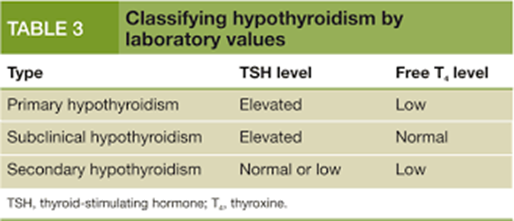
A nurse in a clinic is reviewing the laboratory values of a client who has primary hypothyroidism.
Which of the following laboratory values should the nurse anticipate an elevation of?
A. Free T4
In primary hypothyroidism, the thyroid gland fails to produce sufficient thyroid hormone.Consequently, free T4 levels are typically decreased.
B. Serum T3
Although serum T3 levels may also decrease in primary hypothyroidism due to impaired thyroid function, TSH is the primary marker used for diagnosis and monitoring.
C. Serum T4
Similarly, serum T4 levels may decrease in primary hypothyroidism due to decreased synthesis by the thyroid gland.
D. Thyroid stimulating hormone (TSH)
In primary hypothyroidism, the anterior pituitary gland releases more TSH to stimulate the thyroid gland to produce thyroid hormones. Therefore, elevated TSH levels are characteristic of primary hypothyroidism.
Full Explanation
A. In primary hypothyroidism, the thyroid gland fails to produce sufficient thyroid hormone.
Consequently, free T4 levels are typically decreased.
B. Although serum T3 levels may also decrease in primary hypothyroidism due to impaired thyroid function, TSH is the primary marker used for diagnosis and monitoring.
C. Similarly, serum T4 levels may decrease in primary hypothyroidism due to decreased synthesis by the thyroid gland.
D. In primary hypothyroidism, the anterior pituitary gland releases more TSH to stimulate the thyroid gland to produce thyroid hormones. Therefore, elevated TSH levels are characteristic of primary hypothyroidism.
A nurse is assessing a client who has chronic kidney disease. Which of the following findings is a manifestation of hyperkalemia?
A. Wheezing
Wheezing is not typically associated with hyperkalemia. It can be seen in conditions such as asthma or chronic obstructive pulmonary disease (COPD).
B. Decreased deep tendon reflexes
Hyperkalemia can lead to neuromuscular manifestations, including decreased deep tendon reflexes due to suppression of neuromuscular excitability.
C. Cerebral edema
Cerebral edema is not a typical manifestation of hyperkalemia. It may occur in conditions such as hyponatremia or severe metabolic acidosis.
D. Hypoactive bowel sounds
Gastrointestinal manifestations of hyperkalemia are typically related to smooth muscle involvement and can include hyperactive bowel sounds or diarrhea.
Full Explanation
A. Wheezing is not typically associated with hyperkalemia. It can be seen in conditions such as asthma or chronic obstructive pulmonary disease (COPD).
B. Hyperkalemia can lead to neuromuscular manifestations, including decreased deep tendon reflexes due to suppression of neuromuscular excitability.
C. Cerebral edema is not a typical manifestation of hyperkalemia. It may occur in conditions such as hyponatremia or severe metabolic acidosis.
D. Gastrointestinal manifestations of hyperkalemia are typically related to smooth muscle involvement and can include hyperactive bowel sounds or diarrhea.
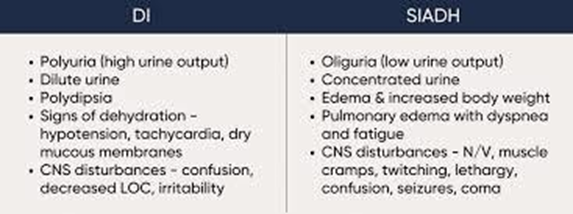
A nurse is assessing a client who had a craniotomy and has developed syndrome of inappropriate antidiuretic hormone (SIADH). Which of the following manifestations should the nurse anticipate?
A. Weight loss
SIADH leads to water retention due to excessive secretion of antidiuretic hormone (ADH), resulting in weight gain rather than weight loss.
B. Oliguria
SIADH causes the kidneys to retain water, leading to decreased urine output (oliguria) and concentrated urine.
C. Hypernatremia
SIADH typically results in dilutional hyponatremia due to water retention, not hypernatremia.
D. Increased thirst
In SIADH, the body retains water excessively, leading to decreased serum osmolality and suppression of thirst, rather than increased thirst.
Full Explanation
A) SIADH leads to water retention due to excessive secretion of antidiuretic hormone (ADH), resulting in weight gain rather than weight loss.
B) SIADH causes the kidneys to retain water, leading to decreased urine output (oliguria) and concentrated urine.
C) SIADH typically results in dilutional hyponatremia due to water retention, not hypernatremia.
D) In SIADH, the body retains water excessively, leading to decreased serum osmolality and suppression of thirst, rather than increased thirst.