
Nursing practice questions with comprehensive rationales
NurseDive Free Nursing Practice Question
A nurse is caring for a client who is obese and is prescribed a calorie reduction of 500 fewer calories per day. The nurse should expect the client to have which of the following rates of weight loss?
A. 0.45 kg (1 lb)/week
The nurse should expect the client to have a weight loss rate of 0.45 kg (1 lb) per week when reducing their calorie intake by 500 calories per day. A general guideline for weight loss is that a calorie deficit of 500 calories per day can lead to a weight loss of approximately 0.45 kg (1 lb) per week. This estimate is based on the notion that 1 pound of body weight is roughly equivalent to 3,500 calories. By creating a calorie deficit of 500 calories per day (500 calories x 7 days = 3,500 calories), the client can expect to lose around 0.45 kg (1 lb) of weight per week. It is important to note that individual factors, such as metabolism and activity level, can influence weight loss rates. Therefore, the actual rate of weight loss may vary among individuals. It is generally recommended to aim for gradual and sustainable weight loss rather than rapid or extreme weight loss.
B. 0.45 kg (1 lb)/day
C. 0.23 kg (0.5 lb)/week
D. 0.23 kg (0.5 lb)/day
This question is an excerpt from Nurse Dive's nursing test bank - ATI RN Nutrition 2019 Proctored Exam. Take the full exam now
Full Explanation
The nurse should expect the client to have a weight loss rate of 0.45 kg (1 lb) per week when reducing their calorie intake by 500 calories per day. A general guideline for weight loss is that a calorie deficit of 500 calories per day can lead to a weight loss of approximately 0.45 kg (1 lb) per week. This estimate is based on the notion that 1 pound of body weight is roughly equivalent to 3,500 calories. By creating a calorie deficit of 500 calories per day (500 calories x 7 days = 3,500 calories), the client can expect to lose around 0.45 kg (1 lb) of weight per week.
It is important to note that individual factors, such as metabolism and activity level, can influence weight loss rates. Therefore, the actual rate of weight loss may vary among individuals. It is generally recommended to aim for gradual and sustainable weight loss rather than rapid or extreme weight loss.
Similar Questions
A nurse is providing teaching to the parents of a toddler about nutritional needs and habits. Which of the following instructions should the nurse include in the teaching?
A. "Set meal times immediately after physical activity."
"Set meal times immediately after physical activity": It is not necessary to schedule meals immediately after physical activity. It is more important to focus on regular meal and snack times throughout the day to ensure the toddler's nutritional needs are met.
B. "Avoid snacks between meals."
"Avoid snacks between meals": Snacks are an important part of a toddler's diet as they have small stomachs and may not be able to consume enough food during regular meal times. Nutritious snacks can provide additional energy and nutrients to support their growth and development. However, it is important to choose healthy snacks and avoid excessive consumption of sugary or high-calorie snacks.
C. "Allow the toddler to feed himself."
The nurse should include the instruction to "allow the toddler to feed himself" in the teaching. Allowing toddlers to self-feed promotes independence and helps develop their fine motor skills. It also allows them to explore different textures and tastes of food, which can contribute to their overall development and acceptance of a variety of foods.
D. "Provide different food for the toddler than the parents."
"Provide different food for the toddler than the parents": It is generally recommended to offer the same types of healthy foods to both the toddler and the rest of the family. This helps promote family meals and exposes the child to a variety of flavors and textures. However, the food may need to be prepared or served in a way that is suitable for the toddler's age and developmental stage (e.g., cut into small pieces or mashed).
Full Explanation
The nurse should include the instruction to "allow the toddler to feed himself" in the teaching. Allowing toddlers to self-feed promotes independence and helps develop their fine motor skills.
It also allows them to explore different textures and tastes of food, which can contribute to their overall development and acceptance of a variety of foods.
"Set meal times immediately after physical activity": It is not necessary to schedule meals immediately after physical activity. It is more important to focus on regular meal and snack times throughout the day to ensure the toddler's nutritional needs are met.
"Avoid snacks between meals": Snacks are an important part of a toddler's diet as they have small stomachs and may not be able to consume enough food during regular meal times.
Nutritious snacks can provide additional energy and nutrients to support their growth and development. However, it is important to choose healthy snacks and avoid excessive consumption of sugary or high-calorie snacks.
"Provide different food for the toddler than the parents": It is generally recommended to offer the same types of healthy foods to both the toddler and the rest of the family. This helps promote family meals and exposes the child to a variety of flavors and textures. However, the food may need to be prepared or served in a way that is suitable for the toddler's age and developmental stage (e.g., cut into small pieces or mashed).
A nurse is providing teaching about breastfeeding to a client who is postpartum. Which of the following statements by the client indicates an understanding of the teaching?
A. "I need to supplement feedings with water once my baby is 4 months old."
"I need to supplement feedings with water once my baby is 4 months old": Breast milk provides all the necessary fluids for the baby, and additional water supplementation is generally not needed for exclusively breastfed infants.
B. "My baby will receive the most milk within the first 10 minutes of the feeding."
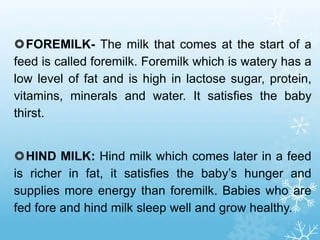
"My baby will receive the most milk within the first 10 minutes of the feeding": This statement is correct. During the first few minutes of breastfeeding, the baby receives the foremilk, which is more watery and quenches their thirst. The hindmilk, which is higher in fat and provides more calories, is obtained as the feeding progresses.
C. "The purpose of alternating breasts during feedings is to promote comfort."
"The purpose of alternating breasts during feedings is to promote comfort": The purpose of alternating breasts during feedings is to ensure that the baby receives both foremilk and hindmilk from each breast and to stimulate milk production in both breasts. It is not primarily for promoting comfort.
D. "During the first few weeks, I should nurse my baby every 4 hours."
"During the first few weeks, I should nurse my baby every 4 hours": Breastfed newborns typically feed more frequently than every 4 hours, especially during the early weeks. On-demand feeding is recommended, which means feeding the baby whenever they show hunger cues, which can be more frequent than every 4 hours.
Full Explanation
"My baby will receive the most milk within the first 10 minutes of the feeding": This statement is correct. During the first few minutes of breastfeeding, the baby receives the foremilk, which is more watery and quenches their thirst. The hindmilk, which is higher in fat and provides more calories, is obtained as the feeding progresses.
"I need to supplement feedings with water once my baby is 4 months old": Breast milk provides all the necessary fluids for the baby, and additional water supplementation is generally not needed for exclusively breastfed infants.
"The purpose of alternating breasts during feedings is to promote comfort": The purpose of alternating breasts during feedings is to ensure that the baby receives both foremilk and hindmilk from each breast and to stimulate milk production in both breasts. It is not primarily for promoting comfort.
"During the first few weeks, I should nurse my baby every 4 hours": Breastfed newborns typically feed more frequently than every 4 hours, especially during the early weeks.
On-demand feeding is recommended, which means feeding the baby whenever they show hunger cues, which can be more frequent than every 4 hours.
A nurse is preparing to initiate enteral feedings for a client who has inflammatory bowel disease. The nurse should recognize that which of the following formulas is appropriate for this client?
A. Hydrolyzed
Hydrolyzed formulas are appropriate for clients who have inflammatory bowel disease. Hydrolyzed formulas are composed of partially or fully broken down nutrients that are easier to digest and absorb. They can also reduce inflammation in the intestinal lining, which can help with Crohn's disease symptoms.
B. High-fiber
High-fiber formulas are not recommended for clients who have inflammatory bowel disease, as they may worsen diarrhea, abdominal pain, and intestinal obstruction.
C. Low-protein
Low-protein formulas are also not suitable, as they may lead to protein malnutrition and impaired wound healing.
D. Low-calorie
Low-calorie formulas are not indicated, as they may cause weight loss and increased disease activity.
Full Explanation
Hydrolyzed formulas are appropriate for clients who have inflammatory bowel disease. Hydrolyzed formulas are composed of partially or fully broken down nutrients that are easier to digest and absorb. They can also reduce inflammation in the intestinal lining, which can help with Crohn's disease symptoms.
High-fiber formulas are not recommended for clients who have inflammatory bowel disease, as they may worsen diarrhea, abdominal pain, and intestinal obstruction.
Low-protein formulas are also not suitable, as they may lead to protein malnutrition and impaired wound healing.
Low-calorie formulas are not indicated, as they may cause weight loss and increased disease activity.