
Nursing practice questions with comprehensive rationales
NurseDive Free Nursing Practice Question
A nurse is caring for a female client who requests a contraceptive diaphragm.
Which of the following actions should the nurse take first?
A. Supervise return demonstration of diaphragm use.
This is not the first action the nurse should take because it assumes that the client already knows how to use the diaphragm correctly and safely. The nurse should first teach the client how to insert, remove, and care for the diaphragm before asking for a return demonstration.
B. Determine the client’s knowledge about diaphragm use
Determine the client’s knowledge about diaphragm use. This is the first action the nurse should take because it allows the nurse to assess the client’s readiness to learn, identify any knowledge gaps, and tailor the teaching to the client’s needs.
C. Document the client’s level of understanding about potential adverse effects.
Document the client’s level of understanding about potential adverse effects. This is not the first action the nurse should take because it is part of the evaluation phase of teaching, not the assessment phase. The nurse should first determine what the client knows and needs to know about diaphragm use and its possible risks and benefits
D. Teach the client how to insert the diaphragm
This is not the first action the nurse should take because it is part of the implementation phase of teaching, not the assessment phase. The nurse should first assess the client’s knowledge, motivation, and preferences before providing instruction on how to use the diaphragm.
This question is an excerpt from Nurse Dive's nursing test bank - ATI Comprehensive Predictor 2023 Exit Proctored Exam A. Take the full exam now
Full Explanation
The correct answer is choice B. Determine the client’s knowledge about diaphragm use. This is the first action the nurse should take because it allows the nurse to assess the client’s readiness to learn, identify any knowledge gaps, and tailor the teaching to the client’s needs.
Some of the other choices are wrong because:
- Choice A. Supervise return demonstration of diaphragm use.
This is not the first action the nurse should take because it assumes that the client already knows how to use the diaphragm correctly and safely. The nurse should first teach the client how to insert, remove, and care for the diaphragm before asking for a return demonstration.
- Choice C. Document the client’s level of understanding about potential adverse effects.
This is not the first action the nurse should take because it is part of the evaluation phase of teaching, not the assessment phase. The nurse should first determine what the client knows and needs to know about diaphragm use and its possible risks and benefits.
- Choice D. Teach the client how to insert the diaphragm.
This is not the first action the nurse should take because it is part of the implementation phase of teaching, not the assessment phase. The nurse should first assess the client’s knowledge, motivation, and preferences before providing instruction on how to use the diaphragm.
A contraceptive diaphragm is a birth control device that prevents sperm from entering the uterus.
It is a small, soft silicone or rubber cup with a flexible rim that covers the cervix.
It is inserted into the vagina with spermicide before sex and is held in place by the pelvic muscles. It is a reusable type of contraception that women can use to avoid getting pregnant.
Similar Questions
A nurse is caring for a client who has a vented NG tube set to low intermittent suction and has vomited.
Which of the following actions should the nurse perform first?
A. Replace the NG tube.
Replacing the NG tube might be necessary if it's dislodged or blocked, but it shouldn't be the immediate action. Evaluating the suction device first can help determine if the NG tube itself is the issue or if the problem lies with the suction.
B. Provide oral hygiene care.
Providing oral hygiene care is important for comfort and to prevent aspiration, but it's not the priority intervention in this situation. Addressing the cause of the vomiting, which could be related to suction malfunction, takes precedence.
C. Administer an antiemetic
Administering an antiemetic might be helpful to control nausea and vomiting, but it doesn't address the underlying cause. Evaluating the suction device first is essential to ensure proper gastric decompression and prevent further vomiting episodes.
D. Evaluate functioning of the suction device
Prompt assessment of the suction device is crucial to determine if it's functioning properly.If the suction is inadequate,it can lead to gastric contents accumulating and potentially causing vomiting. Assessing the suction device first allows for timely interventionif it's not working correctly,preventing further complications and discomfort for the client.
Full Explanation
The correct answer is d. Evaluate functioning of the suction device.
Choice D rationale:
- Prompt assessment of the suction device is crucial to determine if it's functioning properly. If the suction is inadequate, it can lead to gastric contents accumulating and potentially causing vomiting.
- Assessing the suction device first allows for timely intervention if it's not working correctly, preventing further complications and discomfort for the client.
Choice A rationale:
- Replacing the NG tube might be necessary if it's dislodged or blocked, but it shouldn't be the immediate action.
- Evaluating the suction device first can help determine if the NG tube itself is the issue or if the problem lies with the suction.
Choice B rationale:
- Providing oral hygiene care is important for comfort and to prevent aspiration, but it's not the priority intervention in this situation.
- Addressing the cause of the vomiting, which could be related to suction malfunction, takes precedence.
Choice C rationale:
- Administering an antiemetic might be helpful to control nausea and vomiting, but it doesn't address the underlying cause.
- Evaluating the suction device first is essential to ensure proper gastric decompression and prevent further vomiting episodes.
A nurse is providing teaching to a client who is at 14 weeks of gestation about findings to report to the provider.
Which of the following findings should the nurse include in the teaching
A. Bleeding gums
bleeding gums, is wrong because it is a common occurrence during pregnancy due to hormonal changes that increase blood flow to the gums. It is not a cause for concern unless it is excessive or accompanied by other symptoms.
B. Urinary frequency
urinary frequency, is wrong because it is also a normal finding during pregnancy due to the growing uterus putting pressure on the bladder. It is not a sign of infection or kidney problems unless it is associated with pain, burning, or blood in the urine.
C. preeclampsia
Preeclampsia can affect the placenta, the kidneys, the liver, and the brain of the mother and the fetus. It requires immediate medical attention and may lead to early delivery.
D. faintness upon rising
This is a sign of preeclampsia, a serious complication of pregnancy that can cause high blood pressure, proteinuria, and seizures. faintness upon rising, is wrong because it is usually caused by orthostatic hypotension, a drop in blood pressure when changing positions.
Full Explanation
This is a sign of preeclampsia, a serious complication of pregnancy that can cause high blood pressure, proteinuria, and seizures.
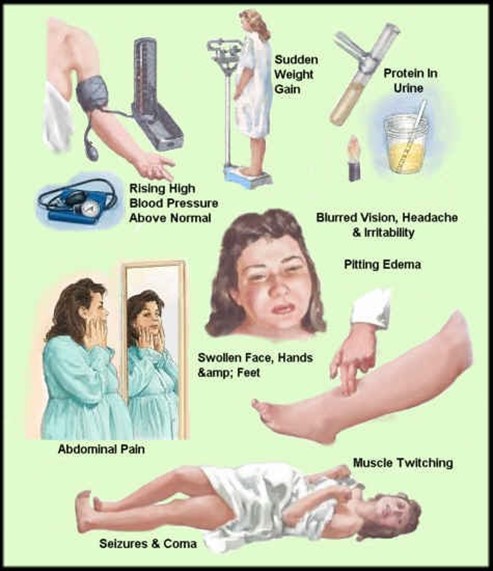
Preeclampsia can affect the placenta, the kidneys, the liver, and the brain of the mother and the fetus. It requires immediate medical attention and may lead to early delivery.
Choice A, bleeding gums, is wrong because it is a common occurrence during pregnancy due to hormonal changes that increase blood flow to the gums. It is not a cause for concern unless it is excessive or accompanied by other symptoms.
Choice B, urinary frequency, is wrong because it is also a normal finding during pregnancy due to the growing uterus putting pressure on the bladder. It is not a sign of infection or kidney problems unless it is associated with pain, burning, or blood in the urine.
Choice D, faintness upon rising, is wrong because it is usually caused by orthostatic hypotension, a drop in blood pressure when changing positions.
This can happen during pregnancy due to the dilation of blood vessels and the increased blood volume. It can be prevented by rising slowly, drinking enough fluids, and avoiding prolonged standing.
A nurse is assessing a client who is experiencing hypovolemia.
Which of the following manifestations should the nurse expect
A. Epistaxis
epistaxis, is wrong because it is not a sign of hypovolemia, but rather a possible cause of it. Epistaxis is a nosebleed that can result from trauma, infection, dryness, or coagulation disorders.
B. Headache
headache, is wrong because it is not a specific sign of hypovolemia, but rather a nonspecific symptom that can have many causes. Headache can be associated with dehydration, but it can also be caused by stress, infection, inflammation, or other factors.
C. Dizziness
Dizziness is a manifestation of hypovolemia, which is a decrease in blood volume due to fluid loss. Hypovolemia can cause orthostatic hypotension, which is a drop in blood pressure when changing positions. This can lead to dizziness, lightheadedness, or fainting.
D. Shortness of breath
shortness of breath, is wrong because it is not a sign of hypovolemia, but rather a sign of fluid volume excess. Fluid volume excess is an increase in blood volume due to fluid retention or overload. Fluid volume excess can cause dyspnea, which is difficulty breathing or shortness of breath. Normal ranges for blood pressure are 90/60 mm Hg to 120/80 mm Hg for adults. Normal ranges for heart rate are 60 to 100 beats per minute for adults.
Full Explanation
, dizziness.
Dizziness is a manifestation of hypovolemia, which is a decrease in blood volume due to fluid loss.
Hypovolemia can cause orthostatic hypotension, which is a drop in blood pressure when changing positions. This can lead to dizziness, lightheadedness, or fainting.
Choice A, epistaxis, is wrong because it is not a sign of hypovolemia, but rather a possible cause of it. Epistaxis is a nosebleed that can result from trauma, infection, dryness, or coagulation disorders.
Choice B, headache, is wrong because it is not a specific sign of hypovolemia, but rather a nonspecific symptom that can have many causes. Headache can be associated with dehydration, but it can also be caused by stress, infection, inflammation, or other factors.
Choice D, shortness of breath, is wrong because it is not a sign of hypovolemia, but rather a sign of fluid volume excess.
Fluid volume excess is an increase in blood volume due to fluid retention or overload. Fluid volume excess can cause dyspnea, which is difficulty breathing or shortness of breath.
Normal ranges for blood pressure are 90/60 mm Hg to 120/80 mm Hg for adults.
Normal ranges for heart rate are 60 to 100 beats per minute for adults.