Nursing practice questions with comprehensive rationales
NurseDive Free Nursing Practice Question
A nurse is teaching a client who has septic shock about the development of disseminated intravascular coagulation (DIC). Which of the following statements should the nurse make?
A. "DIC is controllable with lifelong heparin usage."
"DIC is controllable with lifelong heparin usage": This statement is not accurate. While heparin may be used in the treatment of DIC, it is not a lifelong therapy, and the approach to treatment depends on the underlying cause.
B. "DIC is caused by abnormal coagulation involving fibrinogen."
"DIC is caused by abnormal coagulation involving fibrinogen": This is the correct answer. DIC is a condition characterized by widespread activation of the clotting cascade, leading to the formation of microthrombi throughout the body. Abnormal coagulation involves the consumption of clotting factors, including fibrinogen.
C. "DIC is a genetic disorder involving a vitamin K deficiency."
"DIC is a genetic disorder involving a vitamin K deficiency": This statement is not accurate. DIC is not a genetic disorder, and it is not primarily related to vitamin K deficiency. It is an acquired condition often associated with severe infections, sepsis, trauma, or other critical illnesses.
D. "DIC is characterized by an elevated platelet count."
"DIC is characterized by an elevated platelet count": This statement is not accurate. In DIC, there is often a decrease in platelet count due to consumption and activation of platelets in the widespread formation of microthrombi.
This question is an excerpt from Nurse Dive's nursing test bank - Smith Chason Los Angeles ATI Med Surg Proctored Exam 2. Take the full exam now
Full Explanation
A. "DIC is controllable with lifelong heparin usage": This statement is not accurate. While heparin may be used in the treatment of DIC, it is not a lifelong therapy, and the approach to treatment depends on the underlying cause.
B. "DIC is caused by abnormal coagulation involving fibrinogen": This is the correct answer. DIC is a condition characterized by widespread activation of the clotting cascade, leading to the formation of microthrombi throughout the body. Abnormal coagulation involves the consumption of clotting factors, including fibrinogen.
C. "DIC is a genetic disorder involving a vitamin K deficiency": This statement is not accurate. DIC is not a genetic disorder, and it is not primarily related to vitamin K deficiency. It is an acquired condition often associated with severe infections, sepsis, trauma, or other critical illnesses.
D. "DIC is characterized by an elevated platelet count": This statement is not accurate. In DIC, there is often a decrease in platelet count due to consumption and activation of platelets in the widespread formation of microthrombi.
Similar Questions
A nurse is preparing a client who is scheduled for an echocardiogram the following day. Which of the following instructions should the nurse include about the test?
A. It requires lying quietly on one side."
"It requires lying quietly on one side": This is the correct answer. During an echocardiogram, the client is typically asked to lie on their left side to obtain clear images of the heart. The test is non-invasive and involves using ultrasound waves to create images of the heart's structures.
B. It might cause slight discomfort in the chest area."
"It might cause slight discomfort in the chest area": Echocardiograms are generally painless and do not cause discomfort. They are a non-invasive imaging technique that uses sound waves.
C. "It is best to have no food or beverages the day of the test."
"It is best to have no food or beverages the day of the test": While the client may be instructed to avoid eating or drinking shortly before the test, this statement is too restrictive. The specific fasting instructions will be provided by the healthcare provider or facility.
D. "It takes about 5 or 10 minutes."
"It takes about 5 or 10 minutes": The duration of an echocardiogram can vary, but it typically takes longer than 5 or 10 minutes. The test duration depends on various factors, including the complexity of the study and the information needed.
Full Explanation
A. "It requires lying quietly on one side": This is the correct answer. During an echocardiogram, the client is typically asked to lie on their left side to obtain clear images of the heart. The test is non-invasive and involves using ultrasound waves to create images of the heart's structures.
B. "It might cause slight discomfort in the chest area": Echocardiograms are generally painless and do not cause discomfort. They are a non-invasive imaging technique that uses sound waves.
C. "It is best to have no food or beverages the day of the test": While the client may be instructed to avoid eating or drinking shortly before the test, this statement is too restrictive. The specific fasting instructions will be provided by the healthcare provider or facility.
D. "It takes about 5 or 10 minutes": The duration of an echocardiogram can vary, but it typically takes longer than 5 or 10 minutes. The test duration depends on various factors, including the complexity of the study and the information needed.
A nurse is caring for a client who the provider suspects might have pernicious anemia. The nurse should expect the provider to prescribe which of the following diagnostic tests?
A. Schilling test
Schilling test: This is the correct answer. The Schilling test is used to diagnose pernicious anemia, which is caused by vitamin B12 deficiency. The test measures the absorption of vitamin B12 in the gastrointestinal tract.
B. Haptoglobin
Haptoglobin: Haptoglobin is a test used to assess hemolysis and is not specific for pernicious anemia.
C. Sweat test
Sweat test: The sweat test is used to diagnose cystic fibrosis and is not relevant to the diagnosis of pernicious anemia.
D. Antinuclear antibodies
Antinuclear antibodies: Antinuclear antibodies are tested to diagnose autoimmune disorders, such as systemic lupus erythematosus (SLE), and are not specific to pernicious anemia.
Full Explanation
A. Schilling test: This is the correct answer. The Schilling test is used to diagnose pernicious anemia, which is caused by vitamin B12 deficiency. The test measures the absorption of vitamin B12 in the gastrointestinal tract.
B. Haptoglobin: Haptoglobin is a test used to assess hemolysis and is not specific for pernicious anemia.
C. Sweat test: The sweat test is used to diagnose cystic fibrosis and is not relevant to the diagnosis of pernicious anemia.
D. Antinuclear antibodies: Antinuclear antibodies are tested to diagnose autoimmune disorders, such as systemic lupus erythematosus (SLE), and are not specific to pernicious anemia.
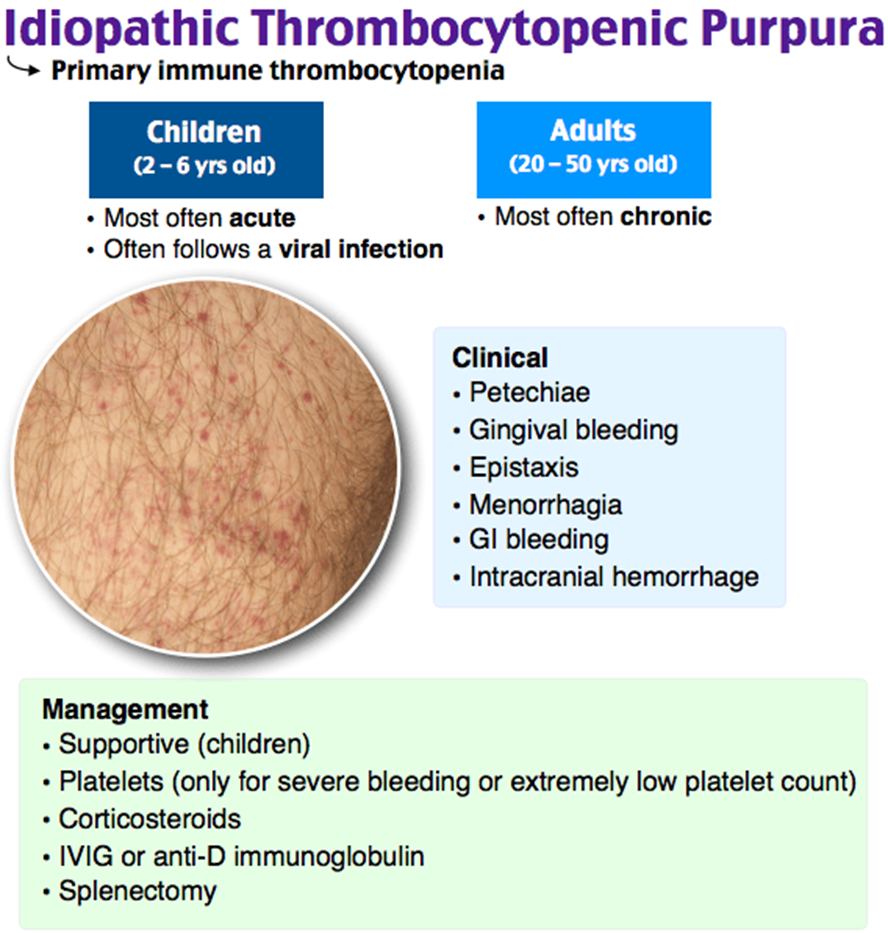
A nurse is reviewing the laboratory findings for a client who has idiopathic thrombocytopenic purpura (ITP). Which of the following findings should the nurse expect to be decreased?
A. RBC
RBC (Red Blood Cells): ITP primarily affects platelet levels, not red blood cells. Therefore, red blood cell counts are not typically decreased in ITP.
B. Platelets
Platelets: This is the correct answer. ITP is characterized by a low platelet count due to immune-mediated destruction of platelets. A decreased platelet count can lead to an increased risk of bleeding.
C. Granulocytes
Granulocytes: While ITP primarily affects platelets, it does not have a direct impact on granulocyte counts. Granulocytes are a type of white blood cell.
D. WBC
WBC (White Blood Cells): ITP primarily affects platelets, not white blood cells. Therefore, white blood cell counts are not typically decreased in ITP.
Full Explanation
A. RBC (Red Blood Cells): ITP primarily affects platelet levels, not red blood cells. Therefore, red blood cell counts are not typically decreased in ITP.
B. Platelets: This is the correct answer. ITP is characterized by a low platelet count due to immune-mediated destruction of platelets. A decreased platelet count can lead to an increased risk of bleeding.
C. Granulocytes: While ITP primarily affects platelets, it does not have a direct impact on granulocyte counts. Granulocytes are a type of white blood cell.
D. WBC (White Blood Cells): ITP primarily affects platelets, not white blood cells. Therefore, white blood cell counts are not typically decreased in ITP.