Nursing practice questions with comprehensive rationales
NurseDive Free Nursing Practice Question
A nurse is teaching a client who has tuberculosis and is to start medication therapy with isoniazid, rifampin, and pyrazinamide. Which of the following instructions should the nurse include?
A. "Expect your sputum cultures to be negative after 6 months of therapy."
A) "Expect your sputum cultures to be negative after 6 months of therapy": While sputum cultures may become negative after a period of effective therapy, it is not always guaranteed to happen within exactly 6 months. Tuberculosis (TB) treatment usually involves several months of medication, and sputum cultures are monitored periodically to assess treatment efficacy, not solely at the 6-month mark.
B. "Drink at least 8 ounces of water when you take the pyrazinamide tablet."
B) "Drink at least 8 ounces of water when you take the pyrazinamide tablet": Drinking plenty of water with pyrazinamide is important to prevent dehydration and to help minimize potential side effects, such as hyperuricemia or gout. Adequate hydration can also aid in the effective elimination of the medication from the body, thus reducing the risk of adverse effects.
C. "Provide a sputum specimen every 2 weeks to the clinic for testing."
C) "Provide a sputum specimen every 2 weeks to the clinic for testing": Sputum specimens are typically provided less frequently than every 2 weeks, usually monthly, to monitor the progress of TB treatment. Testing frequency may vary depending on the client's condition and the healthcare provider's recommendations.
D. "Take isoniazid with an antacid."
D) "Take isoniazid with an antacid": Isoniazid should not be taken with antacids, as antacids can interfere with the absorption of isoniazid. It is usually advised to take isoniazid on an empty stomach, and clients should be instructed to wait at least 1 hour after taking isoniazid before consuming antacids.
This question is an excerpt from Nurse Dive's nursing test bank - ATI Med Surg Proctored Exam 1. Take the full exam now
Full Explanation
Answer: B
Rationale:
A) "Expect your sputum cultures to be negative after 6 months of therapy":
While sputum cultures may become negative after a period of effective therapy, it is not always guaranteed to happen within exactly 6 months. Tuberculosis (TB) treatment usually involves several months of medication, and sputum cultures are monitored periodically to assess treatment efficacy, not solely at the 6-month mark.
B) "Drink at least 8 ounces of water when you take the pyrazinamide tablet":
Drinking plenty of water with pyrazinamide is important to prevent dehydration and to help minimize potential side effects, such as hyperuricemia or gout. Adequate hydration can also aid in the effective elimination of the medication from the body, thus reducing the risk of adverse effects.
C) "Provide a sputum specimen every 2 weeks to the clinic for testing":
Sputum specimens are typically provided less frequently than every 2 weeks, usually monthly, to monitor the progress of TB treatment. Testing frequency may vary depending on the client's condition and the healthcare provider's recommendations.
D) "Take isoniazid with an antacid":
Isoniazid should not be taken with antacids, as antacids can interfere with the absorption of isoniazid. It is usually advised to take isoniazid on an empty stomach, and clients should be instructed to wait at least 1 hour after taking isoniazid before consuming antacids.
Similar Questions
A nurse is providing discharge teaching to a client who has asthma and a new prescription for fluticasone/salmeterol. For which of the following adverse effects should the nurse instruct the client to report to the provider?
A. Dry oral mucous membranes
Dry oral mucous membranes is a common and mild adverse effect of fluticasone/salmeterol, which can be relieved by drinking water, chewing sugarless gum, or using artificial saliva. It does not require reporting to the provider or stopping the medication.
B. White coating in the mouth
White coating in the mouth, also known as oral candidiasis or thrush, is a serious adverse effect of fluticasone/salmeterol, which is a combination of an inhaled corticosteroid and a long-acting beta2 agonist. It is caused by fungal infection of the oral cavity due to suppression of the normal flora by the corticosteroid component. The client should report this symptom to the provider, as it may require antifungal treatment and discontinuation of the medication.
C. Sedation
Sedation is not an adverse effect of fluticasone/salmeterol, but it may be caused by other medications, such as antihistamines, opioids, or benzodiazepines. The client should avoid driving or operating machinery if sedated and consult with the provider about possible drug interactions.
D. Increased appetite
Increased appetite is not an adverse effect of fluticasone/salmeterol, but it may be caused by other factors, such as stress, boredom, or hormonal changes. The client should maintain a balanced diet and exercise regularly to prevent weight gain and promote health.
Full Explanation
White coating in the mouth, also known as oral candidiasis or thrush, is a serious adverse effect of fluticasone/salmeterol, which is a combination of an inhaled corticosteroid and a long-acting beta2 agonist. It is caused by fungal infection of the oral cavity due to suppression of the normal flora by the corticosteroid component. The client should report this symptom to the provider, as it may require antifungal treatment and discontinuation of the medication.
a) Dry oral mucous membranes is a common and mild adverse effect of fluticasone/salmeterol, which can be relieved by drinking water, chewing sugarless gum, or using artificial saliva. It does not require reporting to the provider or stopping the medication.
c) Sedation is not an adverse effect of fluticasone/salmeterol, but it may be caused by other medications, such as antihistamines, opioids, or benzodiazepines. The client should avoid driving or operating machinery if sedated and consult with the provider about possible drug interactions.
d) Increased appetite is not an adverse effect of fluticasone/salmeterol, but it may be caused by other factors, such as stress, boredom, or hormonal changes. The client should maintain a balanced diet and exercise regularly to prevent weight gain and promote health.

A nurse is caring for a client following a total laryngectomy. Which of the following is the priority observation in the client's care?
A. Patency of the intravenous line.
Patency of the intravenous line is important, but not the priority observation in the client's care. The intravenous line provides fluids, electrolytes, and medications to the client, but it does not affect the airway patency or oxygenation.
B. Need for suctioning.
Suctioning is the priority observation in the client's care, as it prevents airway obstruction and respiratory distress caused by blood, mucus, or secretions. The client has a permanent tracheostomy and cannot cough or clear the airway effectively. The nurse should assess the need for suctioning frequently and perform it as needed, using sterile technique and maintaining oxygenation.
C. Integrity of the dressing.
Integrity of the dressing is important, but not the priority observation in the client's care. The dressing protects the surgical site from infection and bleeding, but it does not affect the airway patency or oxygenation.
D. Level of pain.
Level of pain is important, but not the priority observation in the client's care. The pain can be managed with analgesics and nonpharmacological measures, but it does not affect the airway patency or oxygenation.
Full Explanation
Suctioning is the priority observation in the client's care, as it prevents airway obstruction and respiratory distress caused by blood, mucus, or secretions. The client has a permanent tracheostomy and cannot cough
or clear the airway effectively. The nurse should assess the need for suctioning frequently and perform it as needed, using sterile technique and maintaining oxygenation.
a) Patency of the intravenous line is important, but not the priority observation in the client's care. The intravenous line provides fluids, electrolytes, and medications to the client, but it does not affect the airway patency or oxygenation.
c) Integrity of the dressing is important, but not the priority observation in the client's care. The dressing protects the surgical site from infection and bleeding, but it does not affect the airway patency or oxygenation.
d) Level of pain is important, but not the priority observation in the client's care. The pain can be managed with analgesics and nonpharmacological measures, but it does not affect the airway patency or oxygenation.
A nurse is caring for a child who is experiencing status asthmaticus. Which of the following interventions is the priority for the nurse to take?
A. Determine the cause of the acute exacerbation.
Determining the cause of the acute exacerbation is important, but not the priority intervention for the nurse to take. The cause may be an allergen, infection, stress, or exercise, but it does not affect the immediate management of status asthmaticus. The nurse should focus on restoring airway patency and oxygenation first, and then identify and avoid triggers later.
B. Obtain a peak flow reading.
Obtaining a peak flow reading is important, but not the priority intervention for the nurse to take. The peak flow reading measures the maximum expiratory flow rate and indicates the degree of airway obstruction. However, it may not be feasible or accurate in a child who is experiencing status asthmaticus, as they may be too dyspneic or agitated to perform the test. The nurse should rely on other signs or respiratory distress, such as wheezes, retractions, cyanosis, or pulse oximetry.
C. Administer an inhaled glucocorticoid.
Administering an inhaled glucocorticoid is important, but not the priority intervention for the nurse to take. Glucocorticoids, such as fluticasone or budesonide, reduce inflammation and mucus production in the airways, but they have a delayed onset of action and are not effective for acute asthma attacks. They are used for long-term control and prevention of asthma symptoms.
D. Administer a short-acting beta2-agonist (SABA).
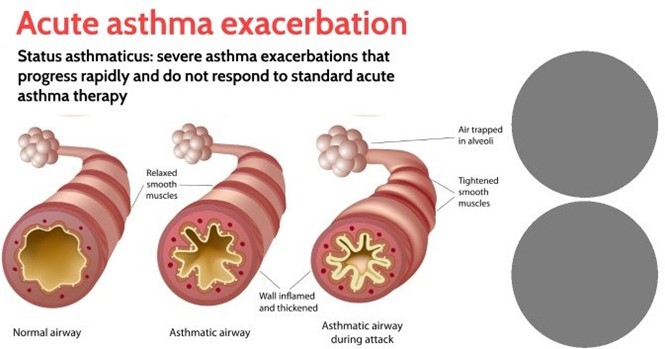
Administering a short-acting beta2-agonist (SABA), such as albuterol, is the priority intervention for the nurse to take, as it provides rapid bronchodilation and relieves bronchospasm, which are the main features of status asthmaticus. Status asthmaticus is a severe and life-threatening asthma attack that does not respond to usual treatment and requires immediate medical attention.
Full Explanation
Administering a short-acting beta2-agonist (SABA), such as albuterol, is the priority intervention for the nurse to take, as it provides rapid bronchodilation and relieves bronchospasm, which are the main features of status asthmaticus. Status asthmaticus is a severe and life-threatening asthma attack that does not respond to usual treatment and requires immediate medical attention.
a) Determining the cause of the acute exacerbation is important, but not the priority intervention for the nurse to take. The cause may be an allergen, infection, stress, or exercise, but it does not affect the immediate management of status asthmaticus. The nurse should focus on restoring airway patency and oxygenation first, and then identify and avoid triggers later.
b) Obtaining a peak flow reading is important, but not the priority intervention for the nurse to take. The peak flow reading measures the maximum expiratory flow rate and indicates the degree of airway obstruction. However, it may not be feasible or accurate in a child who is experiencing status asthmaticus, as they may be too dyspneic or agitated to perform the test. The nurse should rely on other signs of respiratory distress, such as wheezes, retractions, cyanosis, or pulse oximetry.
c) Administering an inhaled glucocorticoid is important, but not the priority intervention for the nurse to take. Glucocorticoids, such as fluticasone or budesonide, reduce inflammation and mucus production in the airways, but they have a delayed onset of action and are not effective for acute asthma attacks. They are used for long-term control and prevention of asthma symptoms.