
Nursing practice questions with comprehensive rationales
NurseDive Free Nursing Practice Question
A parent of a toddler asks a nurse at a well-child visit how the child's frequent temper tantrums can best be handled. Which of the following actions should the nurse suggest to the parent?
A. Distract the child by offering to play a game.
While distraction can sometimes work, it may inadvertently reinforce the tantrum if the child perceives that having a tantrum leads to getting attention or special activities.
B. Tell the child that temper tantrums are not acceptable.
Telling the child that temper tantrums are not acceptable may not be effective as toddlers may not fully comprehend or control their emotions yet. Ignoring the tantrums can also be challenging as it may reinforce the behavior or escalate the intensity.
C. Ignore the temper tantrums.
When a tantrum does happen, parents should ignore it if it isn’t dangerous. When kids get attention for tantrums, they are more motivated to keep having them. Instead, give attention to your child when they do something good. Give lots of praise when they compromise, try to calm themselves down or do something difficult without a tantrum.
D. Restrain the child physically.
Physically restraining the child is not recommended as it can be distressing for the child and potentially cause harm. It is important to use positive and supportive strategies to manage and address temper tantrums in toddlers.
This question is an excerpt from Nurse Dive's nursing test bank - Paediatrics ATI Proctored Exam. Take the full exam now
Full Explanation
Correct answer: C
A. While distraction can sometimes work, it may inadvertently reinforce the tantrum if the child perceives that having a tantrum leads to getting attention or special activities.
B. Telling the child that temper tantrums are not acceptable may not be effective as toddlers may not fully comprehend or control their emotions yet. Ignoring the tantrums can also be challenging as it may reinforce the behavior or escalate the intensity.
C. When a tantrum does happen, parents should ignore it if it isn’t dangerous. When kids get attention for tantrums, they are more motivated to keep having them. Instead, give attention to your child when they do something good. Give lots of praise when they compromise, try to calm themselves down or do something difficult without a tantrum.
D. Physically restraining the child is not recommended as it can be distressing for the child and potentially cause harm. It is important to use positive and supportive strategies to manage and address temper tantrums in toddlers.
Similar Questions
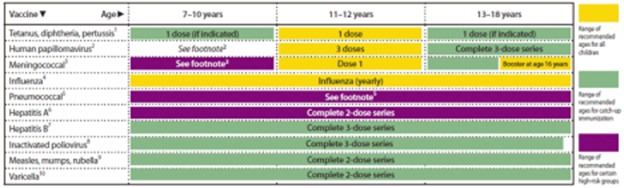
A nurse is administering vaccines at a county health immunization clinic. Which of the following clients should the nurse plan to administer the meningococcal conjugate (MCV4) vaccine?
A. A 4-month-old infant
B. A 2-year-old toddler
C. An 11-year-old school-age child
The MCV4 vaccine is recommended for individuals aged 11-12 years, with a booster dose recommended at age 16. It helps protect against meningococcal disease, which is caused by bacteria and can lead to serious infections such as meningitis or bloodstream infections.
D. A 4-year-old child
Full Explanation
The MCV4 vaccine is recommended for individuals aged 11-12 years, with a booster dose recommended at age 16. It helps protect against meningococcal disease, which is caused by bacteria and can lead to serious infections such as meningitis or bloodstream infections.
A nurse is providing health promotion teaching to an adolescent. Which of the following information should the nurse include in the teaching?
A. "Share piercing needles only with close friends you trust."
B. "Limit your caloric intake to avoid becoming overweight."
C. "Tanning beds are much safer than lying in the sun."
D. “Your need for sleep will increase during periods of growth."
During periods of growth, adolescents often experience an increase in their sleep needs. This is because growth and development processes, such as bone growth and hormonal changes, require adequate rest and sleep. By addressing the increased need for sleep, the nurse can provide valuable information to help the adolescent prioritize and ensure sufficient sleep for their overall well-being. Sharing piercing needles is never recommended as it can lead to the transmission of blood-borne infections such as HIV or hepatitis. Proper sterile techniques and individual use of piercing needles should always be encouraged. It is important to promote a healthy and balanced approach to nutrition rather than focusing solely on limiting caloric intake. Encouraging healthy eating habits, regular physical activity, and a balanced diet is a more appropriate approach to weight management. Tanning beds are not safe alternatives to natural sunlight. They expose the skin to harmful ultraviolet (UV) radiation, increasing the risk of skin cancer and premature aging. It is important to educate adolescents about the risks of tanning beds and promote the use of sunscreen and protective measures when exposed to the sun.
Full Explanation
During periods of growth, adolescents often experience an increase in their sleep needs. This is because growth and development processes, such as bone growth and hormonal changes, require adequate rest and sleep. By addressing the increased need for sleep, the nurse can provide valuable information to help the adolescent prioritize and ensure sufficient sleep for their overall well-being.
Sharing piercing needles is never recommended as it can lead to the transmission of blood-borne infections such as HIV or hepatitis. Proper sterile techniques and individual use of piercing needles should always be encouraged.
It is important to promote a healthy and balanced approach to nutrition rather than focusing solely on limiting caloric intake. Encouraging healthy eating habits, regular physical activity, and a balanced diet is a more appropriate approach to weight management.
Tanning beds are not safe alternatives to natural sunlight. They expose the skin to harmful ultraviolet (UV) radiation, increasing the risk of skin cancer and premature aging. It is important to educate adolescents about the risks of tanning beds and promote the use of sunscreen and protective measures when exposed to the sun.
A nurse is assessing a 6-month-old infant at a well-child visit. Which of the following findings should the nurse expect?
A. Lateral incisors
B. Closed posterior fontanel
The posterior fontanel, located on the back of the head, usually closes by the age of 2-3 months. By 6 months of age, it is expected to be closed. By 6 months of age, infants typically do not have their lateral incisors. The primary incisors, which are the central incisors in the lower and upper jaw, usually erupt first around 6-10 months of age. At around 8 months of age, most infants are able to sit steadily without support. They can maintain an upright sitting position and may even start to reach for objects or play in a sitting position. At 6 months of age, infants are still in the developmental stage of exploring objects and refining their motor skills. They typically use a palmar grasp, where they grasp objects with their entire hand. The pincer grasp, which involves using the thumb and index finger to pick up small objects, usually develops around 9-10 months of age.
C. Sitting steadily without support
D. Uses thumb and index fingers in a pincer grasp
Full Explanation
The posterior fontanel, located on the back of the head, usually closes by the age of 2-3 months. By 6 months of age, it is expected to be closed.
By 6 months of age, infants typically do not have their lateral incisors. The primary incisors, which are the central incisors in the lower and upper jaw, usually erupt first around 6-10 months of age.
At around 8 months of age, most infants are able to sit steadily without support. They can maintain an upright sitting position and may even start to reach for objects or play in a sitting position.
At 6 months of age, infants are still in the developmental stage of exploring objects and refining their motor skills. They typically use a palmar grasp, where they grasp objects with their entire hand. The pincer grasp, which involves using the thumb and index finger to pick up small objects, usually develops around 9-10 months of age.