
Nursing practice questions with comprehensive rationales
NurseDive Free Nursing Practice Question
Because a full bladder prevents the uterus from contracting normally, nurses intervene to help the woman empty her bladder spontaneously as soon as possible.
If all else fails, the last thing the nurse could try is:
A. Pouring water from a squeeze bottle over the woman’s perineum.
This is wrong because pouring water over the perineum may not be enough to trigger the micturition reflex and may cause discomfort or infection.
B. Placing oil of peppermint in a bedpan under the woman.
This is because oil peppermint can stimulate the micturition reflex and help the woman to void.
C. Asking the physician to prescribe analgesics.
This is wrong because analgesics may not address the underlying cause of urinary retention and may have side effects such as drowsiness or nausea.
D. Inserting a sterile catheter.
This is wrong because inserting a sterile catheter is an invasive procedure that carries risks such as trauma, infection, or bladder spasms. It should be used only as a last resort after other methods have failed. Normal ranges for postpartum bladder function are: Urine output: 3000 to 5000 mL/day for the first 2 to 3 days after delivery. Urine specific gravity: 1.005 to 1.030. Urine pH: 4.6 to 8.0.
This question is an excerpt from Nurse Dive's nursing test bank - OB Pediatric Cumulative Exam Test 4 V 1 2023 Proctored Exam. Take the full exam now
Full Explanation

This is because oil peppermint can stimulate the micturition reflex and help the woman to void.
Some possible explanations for the other choices are:
Choice A is wrong because pouring water over the perineum may not be enough to trigger the micturition reflex and may cause discomfort or infection.
Choice C is wrong because analgesics may not address the underlying cause of urinary retention and may have side effects such as drowsiness or nausea.
Choice D is wrong because inserting a sterile catheter is an invasive procedure that carries risks such as trauma, infection, or bladder spasms. It should be used only as a last resort after other methods have failed.
Normal ranges for postpartum bladder function are:
- Urine output: 3000 to 5000 mL/day for the first 2 to 3 days after delivery.
- Urine specific gravity: 1.005 to 1.030.
- Urine pH: 4.6 to 8.0.
Similar Questions
A 25-year-old gravida 2, para 2-0-0-2 gave birth 4 hours ago to a 9-lb, 7-ounce boy after augmentation of labor with Pitocin.
She puts on her call light and asks for her nurse right away, stating, “I’m bleeding a lot.” The most likely cause of afterbirth hemorrhage in this woman is:
A. Retained placental fragments.
This is when parts of the placenta remain attached to the uterine wall and prevent it from contracting properly. It is the second most common cause of postpartum hemorrhage. However, there is no indication in the question that the woman had any difficulty with the delivery of the placenta or that it was incomplete.
B. Unrepaired vaginal lacerations.
This is when there are tears or cuts in the vagina or cervix that cause bleeding. It is a less common cause of postpartum hemorrhage. However, there is no indication in the question that the woman had any trauma during delivery or that she was examined for lacerations.
C. Uterine atony
This is when the uterus does not contract enough to stop the bleeding from the placental site after delivery. It is the most common cause of postpartum hemorrhage, accounting for up to 80% of cases. Uterine atony can be caused by factors such as prolonged or augmented labor, large baby, multiple pregnancies, infection, or retained placenta. The woman in question has some risk factors for uterine atony, such as a large baby and augmentation of labor with Pitocin.
D. Puerperal infection
This is when there is an infection in the uterus or other parts of the reproductive tract after delivery. It can cause fever, pain, and bleeding. It is a rare cause of postpartum hemorrhage. However, there is no indication in the question that the woman had any signs or symptoms of infection, such as fever, chills, or foul-smelling discharge. Normal ranges for blood loss after delivery are less than 500 mL for vaginal birth and less than 1000 mL for C-section. Any amount above these thresholds can be considered postpartum hemorrhage and requires prompt evaluation and treatment.
Full Explanation
Uterine atony.
This is when the uterus does not contract enough to stop the bleeding from the placental site after delivery. It is the most common cause of postpartum hemorrhage, accounting for up to 80% of cases. Uterine atony can be caused by factors such as prolonged or augmented labor, large baby, multiple pregnancies, infection, or retained placenta.
The woman in question has some risk factors for uterine atony, such as a large baby and augmentation of labor with Pitocin.
The other choices are wrong because:
A . Retained placental fragments: This is when parts of the placenta remain attached to the uterine wall and prevent it from contracting properly. It is the second most common cause of postpartum hemorrhage.
However, there is no indication in the question that the woman had any difficulty with the delivery of the placenta or that it was incomplete
B. Unrepaired vaginal lacerations: This is when there are tears or cuts in the vagina or cervix that cause bleeding. It is a less common cause of postpartum hemorrhage.
However, there is no indication in the question that the woman had any trauma during delivery or that she was examined for lacerations
D. Puerperal infection: This is when there is an infection in the uterus or other parts of the reproductive tract after delivery.
It can cause fever, pain, and bleeding. It is a rare cause of postpartum hemorrhage.
However, there is no indication in the question that the woman had any signs or symptoms of infection, such as fever, chills, or foul-smelling discharge.
Normal ranges for blood loss after delivery are less than 500 mL for vaginal birth and less than 1000 mL for C-section.
Any amount above these thresholds can be considered postpartum hemorrhage and requires prompt evaluation and treatment.
What is an important nursing responsibility when dealing with a family experiencing the loss of an infant from sudden infant death syndrome (SIDS)?
A. Explain how SIDS could have been predicted and prevented.
Thisis wrong because explaining how SIDS could have been predicted and prevented is inappropriate. SIDS cannot be prevented or predicted. Discussions about the cause will only increase parental guilt.
B. Interview parents in-depth concerning the circumstances surrounding the infant’s death.
This is wrong because the parents should be asked only factual questions to determine the cause of death. Interviewing parents in-depth concerning the circumstances surrounding the infant’s death may be intrusive and stressful.
C. Discourage parents from making a last visit with the infant.
This is wrong because parents should be allowed and encouraged to make a last visit with their infant. Discouraging parents from making a last visit with the infant may deprive them of an opportunity to say goodbye and grieve.
D. Make a follow-up home visit to parents as soon as possible after the infant’s death.
Make a follow-up home visit to parents as soon as possible after the infant’s death. This is because a competent, qualified professional should visit the family at home as soon as possible after the death and provide the family with printed information about SIDS.
Full Explanation
choice D. Make a follow-up home visit to parents as soon as possible after the infant’s death. This is because a competent, qualified professional should visit the family at home as soon as possible after the death and provide the family with printed information about SIDS.
Choice A is wrong because explaining how SIDS could have been predicted and prevented is inappropriate.
SIDS cannot be prevented or predicted. Discussions about the cause will only increase parental guilt.
Choice B is wrong because the parents should be asked only factual questions to determine the cause of death. Interviewing parents in-depth concerning the circumstances surrounding the infant’s death may be intrusive and stressful.
Choice C is wrong because parents should be allowed and encouraged to make a last visit with their infant. Discouraging parents from making a last visit with the infant may deprive them of an opportunity to say goodbye and grieve.
The nurse is caring for a child with suspected diabetes insipidus. Which clinical manifestation would be observable?
A. Oliguria
This is wrong because oliguria means decreased urine production and is not associated with diabetes insipidus.
B. Glycosuria
This is wrong because glycosuria means glucose in the urine and is associated with diabetes mellitus, not diabetes insipidus.
C. Nausea and vomiting
This is wrong because nausea and vomiting are associated with inappropriate ADH secretion (SIADH), which causes fluid retention and hyponatremia, not diabetes insipidus.
D. Polydipsia
Diabetes insipidus is a disorder of the posterior pituitary gland that causes a deficiency of antidiuretic hormone (ADH). This leads to excessive urination (polyuria) and excessive thirst (polydipsia) as the body tries to balance the fluid loss. These symptoms may be so severe that the child does little other than drink and urinate.
Full Explanation
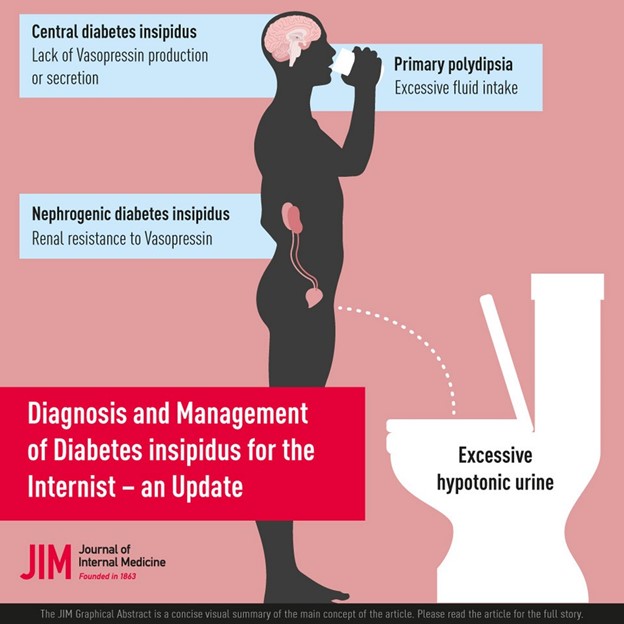
Diabetes insipidus is a disorder of the posterior pituitary gland that causes a deficiency of antidiuretic hormone (ADH). This leads to excessive urination (polyuria) and excessive thirst (polydipsia) as the body tries to balance the fluid loss. These symptoms may be so severe that the child does little other than drink and urinate.
Choice A is wrong because oliguria means decreased urine production and is not associated with diabetes insipidus.
Choice B is wrong because glycosuria means glucose in the urine and is associated with diabetes mellitus, not diabetes insipidus.
Choice C is wrong because nausea and vomiting are associated with inappropriate ADH secretion (SIADH), which causes fluid retention and hyponatremia, not diabetes insipidus.