
Nursing practice questions with comprehensive rationales
NurseDive Free Nursing Practice Question
The nurse is assessing a child with acute epiglottitis.
Examining the child’s throat by using a tongue depressor might precipitate which symptom or condition?
A. Inspiratory stridor
This is wrong because inspiratory stridor is a sign of upper airway obstruction that is aggravated when a child with epiglottitis is supine. It is not caused by examining the throat with a tongue depressor.
B. Complete obstruction
If a child has acute epiglottitis, an examination of the throat may cause complete obstruction and should be performed only when immediate intubation can take place. This is because the inflamed epiglottis can block the airway and cause respiratory distress or failure.
C. Sore throat
This is wrong because sore throat and pain on swallowing are early signs of epiglottitis, not precipitated by examining the throat with a tongue depressor.
D. Respiratory tract infection
This is wrong because respiratory tract infection is the cause of epiglottitis, not a symptom or condition that is precipitated by examining the throat with a tongue depressor. Epiglottitis is caused by H. influenzae in the respiratory tract.
This question is an excerpt from Nurse Dive's nursing test bank - OB Pediatric Cumulative Exam Test 4 V 1 2023 Proctored Exam. Take the full exam now
Full Explanation
If a child has acute epiglottitis, examination of the throat may cause complete obstruction and should be performed only when immediate intubation can take place.
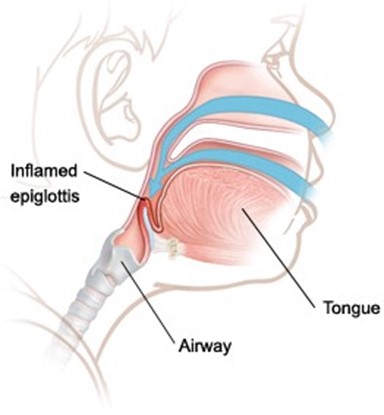
This is because the inflamed epiglottis can block the airway and cause respiratory distress or failure.
Choice A is wrong because inspiratory stridor is a sign of upper airway obstruction that is aggravated when a child with epiglottitis is supine.
It is not caused by examining the throat with a tongue depressor.
Choice C is wrong because sore throat and pain on swallowing are early signs of epiglottitis, not precipitated by examining the throat with a tongue depressor.
Choice D is wrong because respiratory tract infection is the cause of epiglottitis, not a symptom or condition that is precipitated by examining the throat with a tongue depressor.
Epiglottitis is caused by H. influenzae in the respiratory tract.
Similar Questions
It is now recommended that children with asthma who are taking long-term inhaled steroids should be assessed frequently to monitor for increased risk of:
A. Cough
This is wrong because cough is not a side effect of inhaled steroids, but a symptom of asthma itself.
B. Osteoporosis
This is wrong because osteoporosis is not a common side effect of inhaled steroids in children, but a possible risk for adults who use high doses of inhaled steroids or oral steroids.
C. Slowed growth
Slowed growth. Children with asthma who are taking long-term inhaled steroids should be assessed frequently to monitor for this increased risk because some studies have shown a growth delay in children treated with moderate to high doses of inhaled steroids. This appears to occur only during the first year of treatment and may be reversible.
D. Cushing’s syndrome
Thisis wrong because Cushing’s syndrome is not a side effect of inhaled steroids, but a rare complication of oral steroids.
Full Explanation
Children with asthma who are taking long-term inhaled steroids should be assessed frequently to monitor for this increased risk because some studies have shown a growth delay in children treated with moderate to high doses of inhaled steroids. This appears to occur only during the first year of treatment and may be reversible.
Choice A is wrong because cough is not a side effect of inhaled steroids, but a symptom of asthma itself.
Choice B is wrong because osteoporosis is not a common side effect of inhaled steroids in children, but a possible risk for adults who use high doses of inhaled steroids or oral steroids.
Choice D is wrong because Cushing’s syndrome is not a side effect of inhaled steroids, but a rare complication of oral steroids.
A nurse providing care to a child diagnosed with chronic otitis media with effusion (OME) will assess for which sign/symptom?
A. Fever as high as 40° C (104° F)
This is wrong because a fever as high as 40° C (104° F) is a sign of acute otitis media, which is an infection of the middle ear with inflammation and pus formation.
B. Severe pain in the ear
This is wrong because severe pain in the ear is also a sign of acute otitis media, not chronic otitis media with effusion.
C. Nausea and vomiting
This is wrong because nausea and vomiting are not typical symptoms of chronic otitis media with effusion. They may be associated with other conditions such as gastroenteritis or vestibular disorders.
D. A feeling of fullness in the ear
A feeling of fullness in the ear. Chronic otitis media with effusion (OME) is a condition where fluid accumulates in the middle ear without signs of infection.
Full Explanation
Chronic otitis media with effusion (OME) is a condition where fluid accumulates in the middle ear without signs of infection.
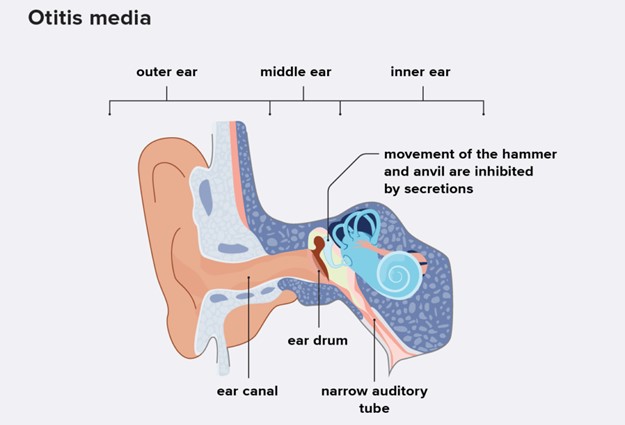
This can cause hearing loss, speech delay, and balance problems. The child may complain of a feeling of fullness or pressure in the ear.
Choice A is wrong because a fever as high as 40° C (104° F) is a sign of acute otitis media, which is an infection of the middle ear with inflammation and pus formation.
Choice B is wrong because severe pain in the ear is also a sign of acute otitis media, not chronic otitis media with effusion.
Choice C is wrong because nausea and vomiting are not typical symptoms of chronic otitis media with effusion. They may be associated with other conditions such as gastroenteritis or vestibular disorders.
The nurse is performing an assessment on a child and notes the presence of Koplik’s spots. In which communicable disease are Koplik’s spots present?
A. Rubella
This is wrong because rubella is a different viral infection that causes a mild rash and fever, but does not have Koplik’s spots.
B. Measles (rubeola)
Measles (rubeola) is a communicable disease that is characterized by Koplik’s spots, which are clustered, white lesions on the buccal mucosa opposite the lower molars. They appear two to three days before the measles rash and are pathognomonic for measles. Choice A is wrong because rubella is a different viral infection that causes a mild rash and fever, but does not have Koplik’s spots.
C. Chickenpox (varicella)
This is wrong because chickenpox (varicella) is caused by the varicella-zoster virus and produces fluid-filled blisters on the skin, not white spots in the mouth.
D. Exanthema subitum (roseola)
This is wrong because exanthema subitum (roseola) is caused by the human herpesvirus 6 or 7 and causes a high fever followed by a pink rash on the trunk and neck, but no oral lesions.
Full Explanation
Measles (rubeola) is a communicable disease that is characterized by Koplik’s spots, which are clustered, white lesions on the buccal mucosa opposite the lower molars. They appear two to three days before the measles rash and are pathognomonic for measles.
Choice A is wrong because rubella is a different viral infection that causes a mild rash and fever, but does not have Koplik’s spots.
Choice C is wrong because chickenpox (varicella) is caused by the varicella-zoster virus and produces fluid-filled blisters on the skin, not white spots in the mouth.
Choice D is wrong because exanthema subitum (roseola) is caused by the human herpesvirus 6 or 7 and causes a high fever followed by a pink rash on the trunk and neck, but no oral lesions.