
Nursing practice questions with comprehensive rationales
NurseDive Free Nursing Practice Question
The nurse observes right-sided weakness and sluggish enunciation of speech. The nurse should immediately take which action?
A. Keep the bed in the lowest position and initiate seizure and fall precautions.
Keeping the bed in the lowest position and initiating seizure and fall precautions is not an immediate action for the nurse to take. Seizure and fall precautions are measures that prevent injury or harm to the client in case of a seizure or a fall. Seizure and fall precautions include lowering the bed, padding the side rails, removing any objects that may cause injury, and having suction and oxygen equipment ready. However, these precautions are not specific to the client's condition and do not address the underlying cause.
B. Place an indwelling urinary catheter and measure strict intake and output.
Placing an indwelling urinary catheter and measuring strict intake and output is not an urgent action for the nurse to take. An indwelling urinary catheter is a tube that drains urine from the bladder into a collection bag. Measuring intake and output is a way of monitoring fluid balance and kidney function. However, these interventions are not essential for the client's condition and may increase the risk of infection or trauma.
C. Maintain elevated positioning of the dependent joints on affected side.
Maintaining elevated positioning of the dependent joints on affected side is not a relevant action for the nurse to take. Dependent joints are joints that are below the level of the heart, such as the ankles or wrists. Elevating dependent joints can help reduce swelling or pain by improving blood flow and drainage. However, this intervention is not related to the client's condition and does not improve neurological function.
D. Start two large bore IV catheters and review inclusion criteria for IV fibrinolytic therapy.
This question is an excerpt from Nurse Dive's nursing test bank - HESI Exit II Proctored Exam. Take the full exam now
Full Explanation
Choice A reason: Keeping the bed in the lowest position and initiating seizure and fall precautions is not an immediate action for the nurse to take. Seizure and fall precautions are measures that prevent injury or harm to the client in case of a seizure or a fall. Seizure and fall precautions include lowering the bed, padding the side rails, removing any objects that may cause injury, and having suction and oxygen equipment ready. However, these precautions are not specific to the client's condition and do not address the underlying cause.
Choice B reason: Placing an indwelling urinary catheter and measuring strict intake and output is not an urgent action for the nurse to take. An indwelling urinary catheter is a tube that drains urine from the bladder into a collection bag. Measuring intake and output is a way of monitoring fluid balance and kidney function. However, these interventions are not essential for the client's condition and may increase the risk of infection or trauma.
Choice C reason: Maintaining elevated positioning of the dependent joints on affected side is not a relevant action for the nurse to take. Dependent joints are joints that are below the level of the heart, such as the ankles or wrists. Elevating dependent joints can help reduce swelling or pain by improving blood flow and drainage. However, this intervention is not related to the client's condition and does not improve neurological function.
Similar Questions
The nurse is caring for a group of clients with the help of a practical nurse (PN). Which nursing action(s) should the nurse assign to the PN? (Select all that apply)
A. Obtain postoperative vital signs for a client one day following unilateral knee arthroplasty.
B. Perform daily surgical dressing change for a client who had an abdominal hysterectomy.
C. Initiate patient controlled analgesia (PCA. pumps for two clients immediately postoperatively.
Initiating patient controlled analgesia (PCA. pumps for two clients immediately postoperatively is not a nursing action that can be assigned to the PN. PCA pump is a device that allows the client to self-administer pain medication through an IV line by pressing a button. PCA pump should be initiated by the nurse after verifying the prescription, setting the parameters, educating the client, and ensuring safety and effectiveness. The PN does not have the authority or competency to initiate PCA pump or adjust its settings.
D. Start the second blood transfusion for a client twelve hours following a below knee amputation.
Starting the second blood transfusion for a client twelve hours following a below knee amputation is not a nursing action that can be assigned to the PN. Blood transfusion is a procedure that delivers donated blood or blood products into the client's bloodstream through an IV line. Blood transfusion should be started by the nurse after verifying the prescription, checking the blood type and compatibility, obtaining informed consent, and monitoring for any adverse reactions. The PN does not have the authority or competency to start blood transfusion or manage its complications.
E. Monitor a dose of warfarin per protocol for a client with type 2 diabetes mellitus (DM).
Full Explanation
Choice C reason: Initiating patient controlled analgesia (PCA. pumps for two clients immediately postoperatively is not a nursing action that can be assigned to the PN. PCA pump is a device that allows the client to self-administer pain medication through an IV line by pressing a button. PCA pump should be initiated by the nurse after verifying the prescription, setting the parameters, educating the client, and ensuring safety and effectiveness. The PN does not have the authority or competency to initiate PCA pump or adjust its settings.
Choice D reason: Starting the second blood transfusion for a client twelve hours following a below knee amputation is not a nursing action that can be assigned to the PN. Blood transfusion is a procedure that delivers donated blood or blood products into the client's bloodstream through an IV line. Blood transfusion should be started by the nurse after verifying the prescription, checking the blood type and compatibility, obtaining informed consent, and monitoring for any adverse reactions. The PN does not have the authority or competency to start blood transfusion or manage its complications.
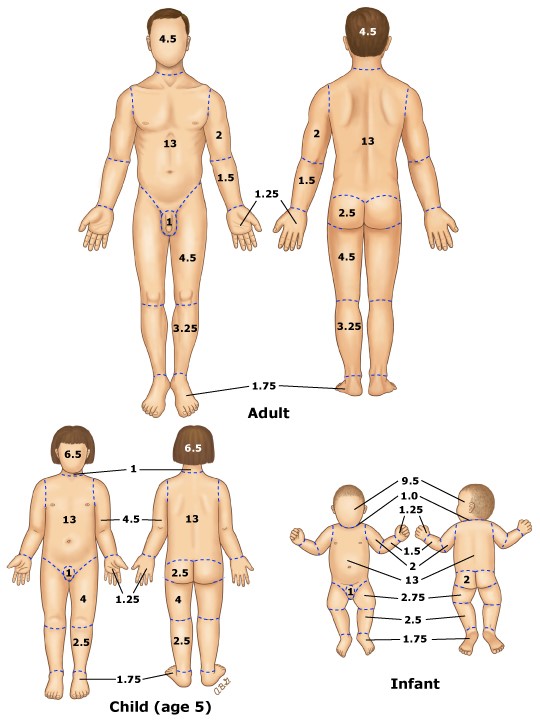
A patient experiences a gasoline tank fire when riding a motorcycle and is admitted to the emergency department (ED. with partial-thickness burns on the anterior surfaces of both lower extremities. Which percentage of body surface area should the nurse document in the electronic medical record (EMR)?
A. 18%.
This is the correct answer.According to the rule of nines, each leg accounts for 18% of the total body surface area, and the anterior surface of each leg accounts for half of that, or 9%. Therefore, the patient has partial-thickness burns on 9% + 9% = 18% of the body surface area.
B. 45%.
This is incorrect. This would be the case if the patient had partial-thickness burns on the anterior and posterior surfaces of both legs, as well as the head and neck, which is not given in the question.
C. 9%.
This is incorrect. This would be the case if the patient had partial-thickness burns on the anterior surface of only one leg, which is not given in the question.
D. 36%.
This is incorrect. This would be the case if the patient had partial-thickness burns on the anterior and posterior surfaces of both legs, which is not given in the question.
Full Explanation
Choice A reason: This is the correct answer. According to the rule of nines, each leg accounts for 18% of the total body surface area, and the anterior surface of each leg accounts for half of that, or 9%. Therefore, the patient has partial-thickness burns on 9% + 9% = 18% of the body surface area.
Choice B reason: This is incorrect. This would be the case if the patient had partial-thickness burns on the anterior and posterior surfaces of both legs, as well as the head and neck, which is not given in the question.
Choice C reason: This is incorrect. This would be the case if the patient had partial-thickness burns on the anterior surface of only one leg, which is not given in the question.
Choice D reason: This is incorrect. This would be the case if the patient had partial-thickness burns on the anterior and posterior surfaces of both legs, which is not given in the question.
The nurse is planning to teach infant care and preventive measures for sudden infant death syndrome (SIDS) to a group of new parents. Which information is most important for the nurse to include?
A. Ensure that the infant's crib mattress is firm.
This is correct because a firm mattress reduces the risk of suffocation and rebreathing of carbon dioxide, which are associated with SIDS.
B. Prop the infant with a pillow when in a side-lying position.
This is incorrect because propping the infant with a pillow can cause the infant to slide down and suffocate or obstruct the airway.
C. Swaddle the infant in a blanket for sleeping.
This is incorrect because swaddling the infant in a blanket can cause overheating, which is a risk factor for SIDS.
D. Place the infant in a prone position whenever possible.
This is incorrect because placing the infant in a prone position can increase the risk of SIDS by impairing gas exchange and thermoregulation.
Full Explanation
Choice A reason: This is correct because a firm mattress reduces the risk of suffocation and rebreathing of carbon dioxide, which are associated with SIDS.
Choice B reason: This is incorrect because propping the infant with a pillow can cause the infant to slide down and suffocate or obstruct the airway.
Choice C reason: This is incorrect because swaddling the infant in a blanket can cause overheating, which is a risk factor for SIDS.
Choice D reason: This is incorrect because placing the infant in a prone position can increase the risk of SIDS by impairing gas exchange and thermoregulation.