
Nursing practice questions with comprehensive rationales
NurseDive Free Nursing Practice Question
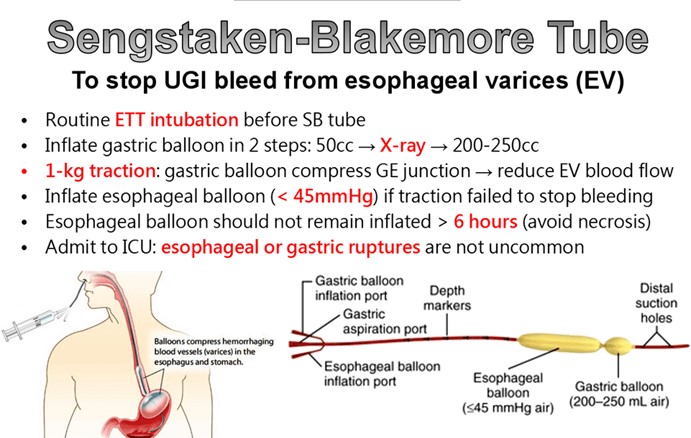
A nurse is caring for a client who has bleeding esophageal varices and is being treated with a Sengstaken-Blakemore tube. Which of the following actions should the nurse perform?
A. Deflate the balloons for 5 min every 2 hr to prevent tissue necrosis.
Reason: This is incorrect. The balloons should not be deflated without a physician's order, as this can cause rebleeding or aspiration.
B. Keep the head of the bed flat at all times to prevent the development of shock.
Reason: This is incorrect. The head of the bed should be elevated to 30 to 45 degrees to reduce pressure on the balloons and prevent gastric reflux.
C. Maintain constant observation while the balloons are inflated.
Reason: This is correct. The nurse should monitor the client closely for signs of complications, such as airway obstruction, aspiration, or balloon rupture. The nurse should also keep scissors at the bedside to cut the tube and release the balloons in case of an emergency.
D. Suction the tube every 2 hr and as needed to maintain patency.
Reason: This is incorrect. The tube should not be suctioned, as this can damage the mucosa and cause bleeding. The nurse should only aspirate gastric contents through the gastric lumen to decompress the stomach.
E. Suction the tube every 2 hr and as needed to maintain patency.
This question is an excerpt from Nurse Dive's nursing test bank - ATI Med Surg 2 Proctored Exam. Take the full exam now
Full Explanation
Choice A Reason: This is incorrect. The balloons should not be deflated without a physician's order, as this can cause rebleeding or aspiration.
Choice B Reason: This is incorrect. The head of the bed should be elevated to 30 to 45 degrees to reduce pressure on the balloons and prevent gastric reflux.
Choice C Reason: This is correct. The nurse should monitor the client closely for signs of complications, such as airway obstruction, aspiration, or balloon rupture. The nurse should also keep scissors at the bedside to cut the tube and release the balloons in case of an emergency.
Choice D Reason: This is incorrect. The tube should not be suctioned, as this can damage the mucosa and cause bleeding. The nurse should only aspirate gastric contents through the gastric lumen to decompress the stomach.
Similar Questions
A nurse is caring for a client who has bleeding esophageal varices and is being treated with a Sengstaken-Blakemore tube. Which of the following actions should the nurse perform?
A. Deflate the balloons for 5 min every 2 hr to prevent tissue necrosis.
Reason: This is incorrect. The balloons should not be deflated without a physician's order, as this can cause rebleeding or aspiration.
B. Keep the head of the bed flat at all times to prevent the development of shock.
Reason: This is incorrect. The head of the bed should be elevated to 30 to 45 degrees to reduce pressure on the balloons and prevent gastric reflux.
C. Maintain constant observation while the balloons are inflated.
Reason: This is correct. The nurse should monitor the client closely for signs of complications, such as airway obstruction, aspiration, or balloon rupture. The nurse should also keep scissors at the bedside to cut the tube and release the balloons in case of an emergency.
D. Suction the tube every 2 hr and as needed to maintain patency.
Reason: This is incorrect. The tube should not be suctioned, as this can damage the mucosa and cause bleeding. The nurse should only aspirate gastric contents through the gastric lumen to decompress the stomach.
Full Explanation
Choice A Reason: This is incorrect. The balloons should not be deflated without a physician's order, as this can cause rebleeding or aspiration.
Choice B Reason: This is incorrect. The head of the bed should be elevated to 30 to 45 degrees to reduce pressure on the balloons and prevent gastric reflux.
Choice C Reason: This is correct. The nurse should monitor the client closely for signs of complications, such as airway obstruction, aspiration, or balloon rupture. The nurse should also keep scissors at the bedside to cut the tube and release the balloons in case of an emergency.
Choice D Reason: This is incorrect. The tube should not be suctioned, as this can damage the mucosa and cause bleeding. The nurse should only aspirate gastric contents through the gastric lumen to decompress the stomach.
A nurse is caring for a client who has hypovolemic shock. Which of the following should the nurse recognize as an expected finding?
A. Flushing of the skin
Reason: This is incorrect. Flushing of the skin is not a sign of hypovolemic shock, but rather of vasodilation or fever. Hypovolemic shock causes vasoconstriction and pale, cool, clammy skin.
B. Oliguria
Reason: This is correct. Oliguria is a decreased urine output that indicates reduced renal perfusion due to hypovolemia. The normal urine output for an adult is 0.5 to 1 mL/kg/hr.
C. Hypertension
Reason: This is incorrect. Hypertension is not a sign of hypovolemic shock, but rather of increased vascular resistance or fluid overload. Hypovolemic shock causes hypotension due to decreased blood volume and cardiac output.
D. Bradypnea
Reason: This is incorrect. Bradypnea is a slow respiratory rate that indicates respiratory depression or fatigue. Hypovolemic shock causes tachypnea due to hypoxia and increased metabolic demand.
Full Explanation
Choice A Reason: This is incorrect. Flushing of the skin is not a sign of hypovolemic shock, but rather of vasodilation or fever. Hypovolemic shock causes vasoconstriction and pale, cool, clammy skin.
Choice B Reason: This is correct. Oliguria is a decreased urine output that indicates reduced renal perfusion due to hypovolemia. The normal urine output for an adult is 0.5 to 1 mL/kg/hr.
Choice C Reason: This is incorrect. Hypertension is not a sign of hypovolemic shock, but rather of increased vascular resistance or fluid overload. Hypovolemic shock causes hypotension due to decreased blood volume and cardiac output.
Choice D Reason: This is incorrect. Bradypnea is a slow respiratory rate that indicates respiratory depression or fatigue. Hypovolemic shock causes tachypnea due to hypoxia and increased metabolic demand.
A nurse in the emergency department is assessing a client who has internal injuries from a car crash. The client is disoriented to time and place, diaphoretic, and his lips are cyanotic. The nurse should anticipate which of the following findings as an indication of hypovolemic shock?
A. Widening pulse pressure
Reason: This is incorrect. Widening pulse pressure is not a sign of hypovolemic shock, but rather of increased intracranial pressure or aortic regurgitation. Hypovolemic shock causes narrowing pulse pressure due to decreased stroke volume and increased peripheral resistance.
B. Increased heart rate
Reason: This is correct. Increased heart rate is a sign of hypovolemic shock, as the body tries to compensate for the decreased blood volume and cardiac output by increasing the heart rate and contractility.
C. Increased deep tendon reflexes
Reason: This is incorrect. Increased deep tendon reflexes are not a sign of hypovolemic shock, but rather of hyperreflexia or tetany. Hypovolemic shock causes decreased deep tendon reflexes due to reduced perfusion and oxygenation of the muscles and nerves.
D. Pulse oximetry 96%
Reason: This is incorrect. Pulse oximetry 96% is not a sign of hypovolemic shock, but rather of normal oxygen saturation. Hypovolemic shock causes decreased pulse oximetry due to hypoxia and impaired gas exchange.
Full Explanation
Choice A Reason: This is incorrect. Widening pulse pressure is not a sign of hypovolemic shock, but rather of increased intracranial pressure or aortic regurgitation. Hypovolemic shock causes narrowing pulse pressure due to decreased stroke volume and increased peripheral resistance.
Choice B Reason: This is correct. Increased heart rate is a sign of hypovolemic shock, as the body tries to compensate for the decreased blood volume and cardiac output by increasing the heart rate and contractility.
Choice C Reason: This is incorrect. Increased deep tendon reflexes are not a sign of hypovolemic shock, but rather of hyperreflexia or tetany. Hypovolemic shock causes decreased deep tendon reflexes due to reduced perfusion and oxygenation of the muscles and nerves.
Choice D Reason: This is incorrect. Pulse oximetry 96% is not a sign of hypovolemic shock, but rather of normal oxygen saturation. Hypovolemic shock causes decreased pulse oximetry due to hypoxia and impaired gas exchange.